CHAMPAGNE’S CAMPAIGNS: The Hall of Fame Cases of Lady Eli and Shared Belief

This past week, I put together a four-way poll on my Twitter page. I’d felt a desire to do some historical legacy-type pieces, so I asked about horses you, the reader, whose Hall of Fame credentials you’d want analyzed.

Naturally, instead of having a clear-cut winner, we had a tie. Rather than wuss out and pick only one (or do a run-off and be subject to yet another tie and/or shenanigans akin to what happens in some countries’ presidential elections!), I’ve decided to combine both opinions in this column, one that I hope gets people thinking and/or talking.

LADY ELI

Okay, here’s the first unpopular opinion of the column, and it centers around the fact that Lady Eli is one of the most popular horses of the past decade for reasons that have little to do with her talent on the racetrack. She stepped on a nail coming back from her scintillating performance in the 2015 Belmont Oaks and eventually contracted laminitis. Of course, she conquered that and came back to the races, where she would win four of her final eight starts (including three Grade 1 events at as many venues).

Get the pitchforks ready: When it comes to Hall of Fame consideration, I don’t care about anything except what a horse does within the confines of its arena. Yes, Lady Eli’s story is a phenomenal one, and credit must be given to the people around her (owner Sol Kumin, trainer Chad Brown, and Brown’s staff). With one exception (which carries a logical excuse), she showed up every single time, even after coming down with a condition that can be fatal. All of that is fantastic, but my Hall of Fame ballot has very little to do with emotion, and very much to do with what a horse accomplishes in its career on the track.

In using the oft-quoted Bill Parcells philosophy, “you are what your record says you are,” here’s what we’ve got as it pertains to Lady Eli.

Record: 14-10-3-0
Earnings: $2,959,800
Stakes Wins (Grade 1 Wins): Nine (Five)
Breeders’ Cup Wins (Appearances): One (Three)

What we have here is a really strong resume, though one that is not without its flaws. First, the good: After breaking her maiden first time out, she raced exclusively in stakes company. She recorded Grade 1 wins in four different seasons, in an era where the most promising horses in the game sometimes struggle to finish a second year of competition. I put a pretty heavy emphasis on longevity and consistency when looking at the horses on the annual ballot, and she checks those boxes emphatically.

Her Breeders’ Cup Juvenile Fillies Turf win was electric, and she nearly added a second such victory when falling by a nose two years later in the Filly and Mare Turf. Her lone clunker came in her final career start, but a reason for the poor effort was evident right away, as she suffered an ugly (though far from life-threatening) injury in last year’s Filly and Mare Turf at Del Mar.

Now, the bad points: Turf horses, by nature, are up against it when it comes to Hall of Fame consideration. There’s a long-held stigma that dirt horses are superior to turf horses, and because of that, some of the best turf horses we’ve seen have to wait a while before being inducted into the Hall of Fame. Lure, for instance, wasn’t enshrined until 20 years after completing a career that included two wins in the Breeders’ Cup Mile. For better or for worse, this hurts Lady Eli.

Additionally, her lack of a race against males is not ideal. Turf mares like Miesque, Goldikova, and even Tepin had multiple wins over the boys on big stages (Miesque and Goldikova are both Hall of Famers, while Tepin will likely get in at some point). None of Lady Eli’s 14 outings came against males, and while such a race isn’t necessary in determining her talent, it would’ve gone a long way at a point where voters are instructed, perhaps even encouraged, to nitpick. If she wins, say, the Grade 1 Fourstardave in 2017 instead of that summer’s Grade 2 Ballston Spa over fillies and mares, or even runs well in defeat in the former race, I don’t think there’s nearly as much question about her eventual Hall of Fame viability.

Ultimately, the question is this: If you take away the phenomenal, made-for-Hollywood story behind Lady Eli’s physical ailments and her recovery, is her on-track resume enough to enshrine her in Saratoga? There will undoubtedly be some that feel her credentials aren’t solid enough, or that she didn’t shine quite as brightly as Tepin (who Lady Eli somehow never ran against, in an oversight of epic proportions by racing offices with high-level, eight to nine-furlong turf races for older fillies and mares at their tracks!).

After minimizing the emotional element, perhaps she’s not a slam-dunk…but I think she did enough to merit induction. I simply cannot ignore a Breeders’ Cup winner that boasts four straight seasons with at least one Grade 1 victory, even if she may not have run against some of the top turf horses of her era.

THE VERDICT: HALL OF FAMER

SHARED BELIEF

Before we cannonball into the deep water, here’s a look at Shared Belief’s career, nutshelled in the same way Lady Eli’s was earlier in this column.

Record: 12-10-0-0
Earnings: $2,932,200
Stakes Wins (Grade 1 Wins): Eight (Five)
Breeders’ Cup Wins (Appearances): None (One)

And now we get to the tough part. The discussion of Shared Belief’s career has to start with the antics that happened at the start of the 2014 Breeders’ Cup Classic. Shared Belief had skipped the Triple Crown due to setbacks at the start of the year, but the son of Candy Ride came back with a vengeance, reeling off four straight wins to come into the Classic undefeated.

Many anticipated a showdown with dual classic winner (and future Hall of Famer) California Chrome. Unfortunately for racing fans, the 3-year-old Shared Belief had to worry about the most was Bayern, who took a hard left turn out of the gate and sent horses inside of him (including Shared Belief) pinballing into one another. When the dust settled, Bayern was left alone on the lead and held off Toast of New York and California Chrome, with Shared Belief left spinning his wheels in fourth.

Shared Belief rebounded from his first career defeat with three straight victories, each more impressive than the one before it. After a workmanlike win in the Grade 1 Malibu, he beat California Chrome on the square in the Grade 2 San Antonio before putting forth one of recent racing history’s most underappreciated brilliant performances in the Grade 1 Santa Anita Handicap.

Think about all of the talent that was on the racetrack in early-2015. American Pharoah would win the Triple Crown. Beholder would destroy the boys in the Pacific Classic. California Chrome was headed to Dubai (followed by a planned start at Royal Ascot), and Bayern was still kicking around in Bob Baffert’s barn. Following the Santa Anita Handicap, though, you’d be hard-pressed to say that any of those horses, on their best days, would’ve been able to beat the Shared Belief that waltzed home in 2:00 and change and seemed capable of so much more.

Alas, fate intervened. In addition to star-crossed California Chrome getting sent to the sidelines, Shared Belief would race just once more. He did not finish the Charles Town Classic after suffering a minor injury that could’ve been much worse if not for the expert skills of Hall of Fame jockey Mike Smith, who pulled him up immediately. Shared Belief was sent to Washington for rehabilitation, and a return was planned, but he suffered an attack of colic in December and was euthanized.

What I’m about to say may seem like a weird tangent, but go with it. I’m a big fan of Bill Simmons’s magnum opus, “The Book of Basketball.” In it, he refers to a theory that applies to a number of players that bordered on greatness, but could’ve been even greater. It goes something like this: If we’d had the ability to simulate a career 10 times, what we got was the worst possible outcome. Athletes that could’ve been great were hampered by injuries, or bad situations, or by things completely outside their control, and if some celestial force were to come and offer a one-time “do-over” as it pertained to one such career, we’d take it without a second thought.

That theory can more than adequately be applied to the career of Shared Belief. He showed brilliance as a 2-year-old, but did not contest the Triple Crown. When he came back, he routed older horses in a pair of Grade 1 races before the Classic, where a series of events produced more outrage than just about any other imaginable scenario (try to think of one that would’ve made people angrier and doesn’t include the words “sniper on the roof;” don’t worry, I’ll wait). After the Classic, he won three times, but was injured in his final career start and never got a chance to come back.

There’s an alternate universe where Shared Belief and California Chrome race each other multiple times at ages three, four, and five. Shared Belief wins a few. California Chrome wins a few. Horse racing gets a rivalry the likes of which it hasn’t seen since the days of Skip Away, Formal Gold, and Wills Way, with longtime horsemen and friends Jerry Hollendorfer and Art Sherman at the forefront, playfully uttering one-liners at each other like, “Well, if I don’t win, I hope you don’t, either.” Add in a rotating cast that includes the likes of Beholder, and perhaps even Arrogate near the end, and how exciting do some Saturdays become?

Feel cheated by the racing gods yet? I know I do. The fact is that there’s absolutely no telling how good Shared Belief could have been. He could’ve been the dirt version of Wise Dan, running his competition into the ground for years due to his status as a gelding rather than a full horse. Instead, he was a comet streaking across the sky, imperfect but undeniably memorable in a way many very talented horses of recent years are not.

Is he a Hall of Famer? That’s about the toughest question the nominating committee will be faced with in a few years, and I’m pretty happy I don’t have to make the decision. At his peak, he may have been the best horse in the world. However, I don’t think he had the opportunity to do as much with his talent as he should have. This is not his fault, nor the fault of those around him. Circumstances conspired to give us the unluckiest possible outcomes with regard to Shared Belief, all the way down to his early passing.

Will I protest if Shared Belief is eventually enshrined in Saratoga? No. Horses without his immense ability have been voted in before, and they’ll be voted in in the future. However, based solely on what he achieved on the track as compared to similar horses from his era, he likely won’t be on my ballot.

THE VERDICT: NOT A HALL OF FAMER
ANALYSIS, SELECTIONS, AND TICKETS: Stars and Stripes Day, Belmont Park (7/7/18)

Saturday is Stars and Stripes Day at Belmont Park, and it marks the beginning of the end of Belmont’s spring-summer meet. Some of the best horses on the grounds will be in action, and several stakes races drew shippers from as far away as Europe. I’ve got several multi-race tickets, and there’s a chance we’ll be able to build a nice stake ahead of the upcoming Saratoga meet. Let’s get to it!

$0.50 Pick Five: Race #1

R1: 4
R2: 2,5,6,7,9
R3: 8
R4: 1,3,5,6
R5: 5,6,7,8

80 Bets, $40

This ticket is built around a pair of horses that will likely be consensus singles. However, if we can get a price or two home around them, this could return a healthy sum.

The first single comes in the opener, a maiden race for 2-year-olds. That’s #4 SOCIAL PARANOIA, the lone entrant in this field with experience. He was a close-up second last time out behind Fully Loaded, who came back to win an allowance event Friday at Gulfstream Park. Any improvement off of his debut would make the 6/5 morning line favorite tough to beat.

The second race is an optional claimer that could double as a minor stakes race almost anywhere else in the country. #6 BREAKING THE RULES is the tepid morning line favorite, but he’s no cinch, and there are a few mid-level prices with big shots. #2 LIFE IN SHAMBLES ran against some tough competition at Aqueduct last winter, while #9 STREET VISION is 2 for 2 since being claimed by David Jacobson. I think both are must-uses in what strikes me as a fascinating event.

The third race, however, seems much more clear-cut. #8 AMERICAN GURU will likely be a heavy favorite, and for good reason. He’s a nose away from being undefeated, and based on the numbers, he’d have to regress pretty significantly off of his last two starts for the others to have a shot.

The fourth is a turf route contested at the 10-furlong route we’ll see in two Grade 1 races later on in the program. #5 RED KNIGHT seems logical, but all of his wins came against state-breds, so I can’t simply single him and move on. A horse that intrigues me at a bit of a price is #1 COUNTY COURT, who won impressively two back before rating in a paceless event in May. A return to the two-back form would make him a contender, and at 6-1 on the morning line, he could knock out plenty of tickets.

The payoff leg is a tricky allowance race, and you’ll want to go as deep as you can. #6 NIGEL’S DESTINY is the morning line favorite, but steps up in class off of a win over a weak field. I’ll use him, but I prefer #8 MR. DOUGIE FRESH, who was a close-up second in a fast race for the level last time out. Additionally, #7 FALLINGINLOVEAGAIN is worth a look at a big price. He won first time out (albeit against weaker foes), has been working well since coming to New York, and attracts Javier Castellano.

$0.50 Pick Five/Pick Four: Race #6/#7

R6: 3,6
– – –
R7: 1,2,4
R8: 1,3,4,5,6,10
R9: 8
R10: 3,4,7

108/54 Bets, $54/$27

There’s no lag time, as we end one Pick Five before quickly starting another. Important note: The Pick Five is only available through one ADW website. If you prefer to play a Pick Four, simply act as though the sixth-race selections don’t exist (which chops the ticket price in half).

The sixth race is the Grade 3 Dwyer, and I’m not getting cute. #6 MENDELSSOHN is my top pick, as I simply think the Kentucky Derby is an absolute throw-out. He was eliminated at the start, and he will be tough if he breaks cleanly here. I’ll also use #3 RUGBYMAN, who adds blinkers after a tough beat in the Easy Goer on Belmont Stakes Day.

The seventh is the Grade 2 Belmont Sprint Championship. #1 LIMOUSINE LIBERAL and #2 WHITMORE are world-class sprinters, but the horse to bet may be #4 SHAFT OF LIGHT, who cuts back after a tough beat in the Grade 3 Salvator Mile. For such a high-profile sprint, there isn’t much early speed signed on. If Shaft of Light gets out early, he could be tough to catch when the real running starts.

The eighth is the Grade 1 Belmont Oaks, and this struck me as the best betting race on the card. You’ll get a price on whatever horse(s) you like, and I felt the need to go deep. The longshot of the group is #3 PAVED, who’s 12-1 on the morning line but runs like a horse that will appreciate the 10-furlong distance. She’s got enough tactical speed to not be too far back early, and if she shows the late kick she displayed in the Grade 2 Honeymoon, she’ll have a big shot.

My single comes in the ninth, the Grade 2 Suburban. Bob Baffert has two in here, but while #5 DR. DORR is the morning line favorite, I prefer #8 HOPPERTUNITY, who’s 2 for 2 at Belmont and won the 2016 Jockey Club Gold Cup at this route of ground. His lone loss this season came over a speed-favoring track in the Grade 2 Alysheba, and even if he’s lost a step at age 7, I think he’s the horse to beat if he fires his best shot. He’s 9/2 on the morning line, and I’m hoping we get that price.

The payoff leg is the Grade 1 Belmont Derby, and I’m going three-deep. #7 CATHOLIC BOY and #3 ANALYZE IT finished 1-2 in the local prep for this race, and both could win, but European shipper #4 HUNTING HORN looks very dangerous. He’s improved with every start to this point in his career, and his recent Group 3 win was incredibly impressive. I’m always partial to European shippers adding Lasix, as he does, and I need to have him on my tickets.

ANALYSIS, SELECTIONS, AND TICKETS: Queen’s Plate Day at Woodbine, Mandatory Rainbow 6 Payout at Gulfstream

Some may consider the time between the Belmont Stakes and the start of Saratoga and Del Mar to be a bit slow, but Saturday’s got ample opportunity for a handicapper to make a big score. It’s Queen’s Plate Day at Woodbine, and there’s also a mandatory payout in the Rainbow 6 at Gulfstream Park. I’ve got a ton of tickets below, and with a little bit of luck, we’ll be able to connect with a few and have a big day!

WOODBINE

$0.20 Pick Five: Race #2

R2: 1,5,9
R3: 2,4,6
R4: 2,5,9
R5: 1,4,5
R6: 7,8

162 Bets, $32.40

Yep, handicapping Woodbine means we get to dabble in 20-cent exotic wagers. This isn’t something that could work at all tracks, but at Woodbine, the concept is tremendous. Most people play for this denomination, so the payoff isn’t nearly as low as you’d expect, and you can get meaningful coverage without breaking the bank.

This Pick Five is a tough one, and it begins with a 2-year-old race. Mark Casse has a very strong hand, as #1 SOUL PLANET and #5 LIMONAIA are both logical contenders. I’m also going to use #9 CON ARTIST, who debuts for the Mike Maker barn and sports a flashy half-mile drill on June 23rd. This one may need a bit more ground, but if the most recent work is any indication, she can run a bit.

The second leg is the Charlie Barley Stakes, and I’ve gone three-deep. #4 MACHTREE is a logical favorite off of two strong races on the synthetic main track, but I don’t think he’s a cinch, and he may not even be the most well-meant entry from the Mark Casse barn. I’ll also use #6 RIDE A COMET, who’s undefeated on turf, and #2 BLUEBLOOD, who may have needed the race two back and figures to be prominent early.

The third leg also starts off a Pick Four (more on that later), and #5 ERADICATOR is a sound favorite. He drops way down in class and ran well two back at this level, but his lone win came against a suspect group last October, so I can’t have a ton of faith in him. I’m also including #2 SCRAM CRACKER, who may have figured things out given his recent score off a long layoff, and #9 SOUTHERN GREATNESS, whose record looks much better if you toss the turf races and solely focus on synthetic form.

The fourth leg features a full field of 14 maidens, and this is far from easy. In my Pick Four, I went five-deep, but in an effort to keep this ticket affordable, I whittled my coverage to a trio of horses. #1 BETH’S AURORA responded to the drop in class last time out, while #4 STORMY SUMMER cuts back after showing early speed last time out and #5 MAXIXE is another that should be prominent out of the gate.

The payoff leg is the Grade 2 King Edward, and I’m taking a bit of a stand in this wager (though I’m hedging a bit in the Pick Four, as you’ll see). I respect #3 TOWER OF TEXAS, but his two wins in the last year have come against much weaker groups. In fact, the winner of his last race, #7 CARIBOU CLUB, has turned into one heck of a turf horse, and he’s my top pick. Caribou Club has won four of his last five races, yet is somehow triple the price of Tower of Texas on the morning line. If he’s 6-1 come post time, I want all of it. Additionally, I’ll throw in #8 DELTA PRINCE. Royal Delta’s little brother turned into a strong turf horse last season, and while the long layoff is a bit of a concern, Jimmy Jerkens seems to have this one sitting on a big race, judging by the recent workouts at Belmont Park.

$0.20 Pick Four: Race #4

R4: 2,5,9
R5: 1,4,5,8,12
R6: 3,4,7,8
R7: 2,3

120 Bets, $24

As mentioned, this sequence starts midway through the Pick Five. With that in mind, there’s a lot of overlap, but also some room to add a few horses I didn’t have the budget to use in that sequence.

I’m using the same three horses in the fourth, but adding two in the fifth. #8 FASHION FLIRT has been working very well, but goes out for a trainer that’s winless to this point in the season. This doesn’t appear to be the strongest group, so I at least want to use her in SOME fashion. Additionally, #12 DANCE READY drops in for a tag for the first time. She’s got some speed, and the presence of Eurico da Silva is a plus.

In the sixth, I’ll throw in Tower of Texas, as well as #4 FIRST PREMIO. First Premio is a Mark Casse trainee whose form looks much better if you toss the two dirt races. Simply put, he’s a turf/synthetic horse. The last-out win at Churchill was good, although he stalked a pretty slow pace that day, and while this is a class test and we may not get much value, I did need to throw him in.

The seventh race appears to be a split of the second, as the conditions are exactly the same. In case you haven’t figured it out, I think Mark Casse could be in line for a colossal day, and I’m using both of his runners here. #2 SAILING BY and #3 SI SI TEQUILA can both build on their debuts, and while I’m using a few others in the late Pick Five, those are the horses I consider primary win threats.

$0.20 Pick Five: Race #6

R6: 7,8
R7: 2,3,4,6
R8: 5,7,8
R9: 2,4,6
R10: 4,10

144 Bets, $28.80

I’m solely using my two top picks in the sixth, but I’m spreading in the seventh, since I’ve got room in the budget to do that. I’m throwing in #4 IT’S VENGEANCE, a first-time starter from the Roger Attfield barn, and #6 TRULY HONORED, who ran well first time out. The former may want a bit more distance given the pedigree, and the latter is wheeled back pretty quickly, but this at least gives me a bit more coverage.

The third leg is the Grade 2 Dance Smartly for older fillies and mares. I cannot get past the three likely betting choices in here. #5 HOLY HELENA won last year’s Queen’s Plate, while #7 INFLEXIBILITY and #8 SANTA MONICA ship up for trainer Chad Brown. I think this trio is pretty far above the rest of the field, and I’ll be pretty surprised if another horse wins.

The fourth leg is the Grade 1 Highlander, a turf sprint that’s drawn a fun field. I had to use #2 IMPRIMIS, but while he’s undefeated, he’s never gone beyond five furlongs, and I’m not sure how he’ll like the long stretch at Woodbine. With that in mind, my top pick is #6 LONG ON VALUE, who came back running last time out and ran well here in last year’s Grade 1 Woodbine Mile. Additionally, I’ll throw in #4 HOLDING GOLD, who was caught very wide last time out in the Grade 2 Jaipur and could improve at a square price with a better trip.

This brings us to the main event, the $1 million Queen’s Plate. There are 16 runners, but I’m only going two-deep, and one of the ones I like figures to be a price. My top pick is #10 TELEKINESIS, who has done very little wrong to this point in his career and was a strong winner of the Plate Trial. Mark Casse seems to have been eyeing this race all along, and he could sit a perfect stalking trip just off the pace. The other one I need to use, though, is #4 STRIKE ME DOWN, who’s bred up and down for this distance and has taken a definite step forward as a 3-year-old. That one is 10-1, and given the pedigree (by Tapit, out of a Smart Strike mare), I must use him. If he wins, he’ll drive up the value of this sequence significantly.

GULFSTREAM PARK

$0.20 Rainbow 6: Race #9

R9: 6,7,8,9 (same)
R10: 2,9,10 (or 2,9)
R11: 15 (or 1,4,9,10,13)
R12: 1,2,3 (same)
R13: 8 (same)
R14: 1,4,5 (or 1,5)

108 (or 240) Bets, $21.60 (or $48)

As you can see, there are two different tickets given out. There’s a logical reason for this, as there’s an also-eligible in the third leg that strikes me as a real standout. If that one runs, I think it’s a single. If it doesn’t, that’s a race where you want coverage.

We’ll start off with a maiden claimer, and I don’t like the form of any horse in here that’s run before. I’m using four first-time starters, and of the quartet, I’m most intrigued by #7 BARGAINAIRE, who’s been working pretty well for trainer Ralph Nicks. Nicks can get a horse ready to run first time out, and 4-1 seems like a slight overlay.

Things don’t get much more visually appealing in the second leg, another maiden claimer. This time, they’re going long on the turf. My two primary horses are #2 FRIEND ZONE, who drops down in class, and #9 SPANISH DUDE, who debuted going long (never easy to do) and has several works indicating some potential. On one ticket, I’ve also used #10 ASSERTION, who’s 0 for 15 and drew poorly but seems like a much better horse on turf than on dirt.

The third leg is a pivotal one. If #15 DREAM SATURDAY runs, he’ll likely be a pretty heavy favorite, and for good reason. He won three in a row at this level before being claimed and running over his head in the starter allowance ranks, and while the low-percentage barn is a concern, he doesn’t need to be much to best this group. If he doesn’t run, though, I’m spreading, using five horses in what seems like a wide-open event. If forced to name a top selection, it’d be #13 JERSEY STREET, who’s a bit of a price (10-1) on the morning line. His three starts on non-boggy tracks since the claim have been solid, and he was an OK second at this level last time out.

The fourth leg is the Grade 2 Princess Rooney. Longtime horse for course #1 CURLIN’S APPROVAL will be a short price, and I’m using her, but on figures, she’s taken a bit of a step back from her 2017 form. Her best race wins this, but I can’t just single her against a decent group. #2 MS LOCUST POINT ran against top-class foes in the Grade 1 Madison two back before catching a mess of a track at Pimlico, while #3 MY MISS TAPIT is undefeated going one turn and merits respect.

In the fifth leg, though, I have no such reservations about singling a heavy favorite. That’s #8 X Y JET, who did everything but win last time out in Dubai. It’s taken him a while to get right, but trainer Jorge Navarro has him going in the right direction, and if he’s himself in this spot, everyone else is running for second money.

The payoff leg is another maiden claimer, the third in this sequence. My two primary horses are #1 ALLURSTRA, whose race two back against better wasn’t terrible, and #5 TALKING POINT, who took a step forward last time out and gets Tyler Gaffalione. On one proposed ticket, I’m also using #4 XIROMA, who ran well off the layoff last time out but may want a bit longer than this six-furlong distance.

CHAMPAGNE’S CAMPAIGNS: The Value of Fan Education, And a Tweet Gone Horribly Wrong

This past Saturday, I spent some time at Oak Tree Pleasanton. The folks there invited me to help out with a handicapping seminar, and I had a blast going through the card and offering my thoughts on the day’s races. It apparently went well, as I shook a few hands afterwards and heard from people who enjoyed it.

I’ve always dug doing that kind of stuff, especially when it leads to people potentially making some money (I’m proud to report my top picks went 5 for 10 with a $2.96 ROI, so there was plenty of room for profit). Given how many of us were introduced to the game (being taken to the track by a parent, or a friend, or another family member), I think it’s the responsibility of those in the game to either bring someone to the track or take the time to explain what’s going on.

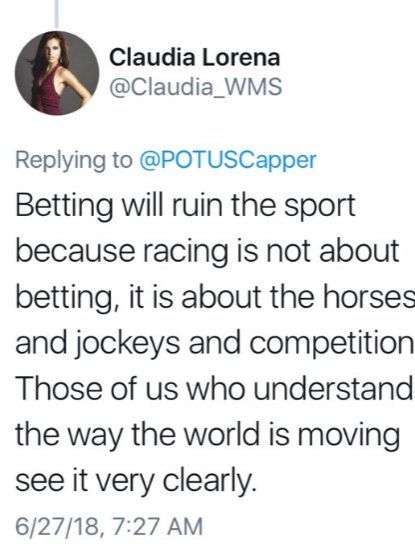
All of this serves as a preface to the since-deleted tweet that sent the handicapping section of horse racing Twitter into a frenzy Wednesday morning.

DgtN3HsXkAEbHld

I’m going to try to frame this as delicately as possible, for any number of reasons. On a fundamental level, the content of this tweet is as wrong as wrong can be, and pretty much everyone who responded to it said as much. This is as good a time as any to cue the Richard Dreyfuss line from “Let It Ride.”

DgtlkD1V4AAiPJu

Thanks, Danny!

Racetracks are based on two main sources of income: Owners who buy and race their horses, and gamblers who bet on them. All of this funds the tracks, which put up purse money. Without either part of that one-two punch, tracks are doomed to fail. Saying betting will ruin the sport goes against lots of established logic, because the truth is that large-scale racing could not survive without it.

If people aren’t betting, racing cannot thrive. The question isn’t just, “How do we get racing fans to the track, or to an ADW?” The second question, which is just as important, is, “How do we provide a foundation for new fans to bet with some degree of confidence once they decide to invest their money?”

One of my longtime friends dating back to my two summers in the Saratoga press box is Tom Amello, a longtime handicapper who prides himself on fan education. He did a seminar at the racing Hall of Fame prior to the 2013 meet, and he did a great job of keeping things simple and relatable. His concepts centered around the odds board and four basic types of fields that can assemble in a given race, and it came across as something simple enough for new fans to understand.

Tom knows what he’s talking about, and he’s got a lot of valid points. The problem isn’t that people are betting too much and losing sight of the other stuff. The problem is, in many ways, the exact opposite. It can be intimidating for new fans to come to the races and not have a clue what they’re looking at or how to make money.

One of the things I try to do with my DRF Formulator Angle segments, which more often than not go against likely favorites, is explain why I’m going against the grain. While much of my analysis is grounded in the numbers Formulator provides, a fair part of it deals with various parts of the form that can be spelled out. Every horseplayer has angles they’re partial to. If what I do helps one person find an angle that works for them and the way they’re comfortable wagering, that’s a win. If that person uses that angle to cash a ticket, that’s an even bigger victory.

Racing does a good job of spreading the glamorous reasons to go to the track. Having said that, what are we doing once they get there so that they keep coming back, and not just for Instagram photos? Sorry, folks: Photos in fancy outfits don’t keep the sport going. Cold, hard cash at the betting windows? That’s a different story.

(Important note: If I turn up missing in the next few days, chances are that paragraph is why!)

I attempt to bridge the information gap every day when handling DRF’s social media platforms. My goal is to make the people who see our content more aware of what’s going on so that they can consume it in the most productive way possible. Hopefully, what I’m doing is bringing content to the attention of fans who will be enriched by it. The rule of thumb I’ve always abided by is that smarter fans are better fans. If smarter fans are compelled to do more to be invested in our game (whether that’s gambling on the races or raising awareness of them), then I’ve done my job effectively.

Speaking from that experience, I think there’s more we could be doing to be more welcoming to newer fans with money to burn, and if you’re taking the time to read this, you’re part of the solution. Making new fans that are inclined to gamble is of paramount importance, and that’s something we need to do given the likelihood of legalized sports betting in the near future.

If racing does not put up a fight, the sport stands to lose significant revenue to its organized sports betting cousins that don’t have this problem. Why would a group of people bet on something they don’t understand when they’ve been watching sports their entire lives and can form justifiable opinions on them without much effort?

Contrary to a tweet that went viral Wednesday morning, we DO need gambling money, possibly now more than ever. Sharing the game and knowledge within it with someone who could benefit from it is the single most productive thing one can do.

If you’ve got insight, share it. If you’ve got advice and new players can stand to benefit from it, help them out. You were there once, and someone helped you understand what was going on. It’s your duty to return the favor, so that there’s a game for us to enjoy in the years to come.

CHAMPAGNE’S CAMPAIGNS: The Ballad of Big Brown

Even though I was there, I don’t remember much about the 2008 Belmont Stakes. My main memory of that day is picking out a spot on the third level of the Belmont Park grandstand an hour before the race. The crowd began packing everyone in like sardines, and in an effort to hold my position across from the sixteenth pole, I clutched a sign advertising the section below it for dear life. It wasn’t pretty, but after a few minutes of pushing, people got the idea that I wasn’t moving.

It’s taken me 10 years, but I’ve realized that’s a heck of a metaphor for the way racing fans hold on to certain beliefs. We hold on tight, with white-knuckled grips that signify either deeply held convictions or immense fears of being wrong, but either way, when such a topic arises in conversation, we’ll speak our respective pieces as loudly as we can.

I was a college student then. I’d just finished my sophomore year at Ithaca College, and much as I had for Funny Cide and Smarty Jones, I had successfully persuaded a parent (in this case, my father) to take me to the Belmont.

I watched with baited breath as Big Brown, the easiest of winners in both the Kentucky Derby and Preakness, strolled into the starting gate. The crowd’s buzz was audible, as it had been during my prior ventures to cancelled coronations in both 2003 and 2004.

The horses settled in the starting gate, among them the undefeated Big Brown, with Hall of Fame jockey Kent Desormeaux in the irons.

The race started.

And then, an instant later, it was over.

– – – – –

I got the inspiration to write this column from a brief discussion with Desormeaux on Twitter Wednesday morning. I’d just woken up, 45 minutes before the start of my work day, and I saw that he’d retweeted something saying he was online and answering questions.

Having heard several theories on what happened that muggy Long Island afternoon, and having not yet acquired the filter that comes with consciousness, I asked if any of the conspiracy theories about that afternoon held water. Desormeaux, predictably, was not amused.

There was, however, an ulterior motive to my line of questioning. If you ask a group of racing fans who the top horse of the mid to late-2000’s was, you’ll get a fair variety of responses. Many fans will say either Zenyatta or Rachel Alexandra. Some will say fellow Hall of Famer Curlin, or even Rags to Riches (the filly who edged the two-time Horse of the Year in the 2007 Belmont). Barbaro will also be fondly remembered, if only for the memories of what might have been if not for his catastrophic injury in the Preakness. Big Brown’s name likely doesn’t come up in that conversation. For various reasons, the bay son of Boundary isn’t seen as one of the best of his generation, despite wins in every single race he finished.

Much of this is undoubtedly due to the horse’s connections, which seemed to be under an interminable cloud of controversy. Big Brown was owned by IEAH Stables, which operated as horse racing’s version of a hedge fund. They had achieved considerable success with horses like 2007 turf champion Kip Deville and eventual 2008 champion sprinter Benny the Bull, but something about the enterprise did not mesh well with the racing establishment.

As the excellent Deadspin article on IEAH cited, perhaps it was the “new money” aspect of the organization that rubbed some the wrong way. What did not help the public perception of the enterprise, though, was IEAH’s trainer of choice. Rick Dutrow was one of the most gifted horsemen on the NYRA circuit, one that many feel was railroaded when he was slapped with a 10-year suspension. He was also brash, opinionated, and never afraid of a microphone, especially when the topic of conversation was one of his fastest trainees. As gifted a conditioner as he was, Dutrow did himself no favors when it came to public relations.

Horses cannot choose their connections. Many of the four-legged immortals whose form we admire were so talented that their owners and trainers were, in some way, bystanders to their brilliance, just like the rest of us. Man o’ War was that way. So was Secretariat. A case could be made for Zenyatta as well, given her personality and tendency to prance around walking rings as if she owned them (with one exception, she may as well have).

Even if he had cruised to victory in the Belmont Stakes, Big Brown would have never had that luxury. His owners were not the “happy to be there” types, nor was his trainer. A sect of the racing industry would have viewed Big Brown as the black sheep of the Triple Crown winners, horse racing’s equivalent to the cousin or uncle that never gets invited over for Thanksgiving dinner. In no way is this the fault of a supremely talented racehorse that was on the verge of greatness, but such is the legacy of Team Big Brown.

For these reasons, Big Brown has been given the short end of the stick for a decade. In no way is this more evident than when you compare the 2008 standout to a horse of more recent vintage that hit a similar wall (or, more accurately, was hit by a similar hoof) when going a mile and a half in New York.

– – – – –

The year was 2014. A California-bred of humble beginnings had taken the horse racing world by storm, and was now one Big Sandy lap away from doing what Funny Cide, Smarty Jones, and Big Brown could not.

California Chrome walked into the starting gate beneath Victor Espinoza, whose career the son of Lucky Pulpit almost singlehandedly revived. Once again, I was there. This time, I was on assignment for HRTV, and I was watching not from the grandstand, but from the Long Island Railroad platform near the top of the stretch, less than 100 yards from the HRTV trailer.

Chrome broke a bit awkwardly, but settled into what seemed like a fine trip. Turning for home, he looked like a winner, and Espinoza began pumping his arms. However, when the eventual Hall of Fame reinsman stepped on the gas pedal, he found that the tank was empty. California Chrome hung and settled for fourth behind Tonalist.

Within 24 hours, former HRTV and TVG colleague Scott Hazelton had unearthed a reason for Chrome’s flat performance. Matterhorn, a hopeless longshot in the race, had stepped on the Triple Crown hopeful out of the gate, causing a massive gash that took social media by storm. In the eyes of the racing world, California Chrome’s effort went from disappointing to borderline heroic, and followers eagerly waited to see when the fan favorite would return to the track.

He raced three more times that year. He was once again one-paced in the Pennsylvania Derby, which was unapologetically viewed by his connections as both a prep and a paid workout given the incentives offered by Parx. He then ran a strong third in the Breeders’ Cup Classic, a race marred by Bayern’s antics out of the starting gate and a non-disqualification that’s even more indefensible now than it was at the time, before cruising home in the Grade 1 Hollywood Derby on turf at Del Mar. Despite losing to Bayern twice, and despite failing to win a Grade 1 on dirt after the Preakness, California Chrome was voted the 2014 Horse of the Year.

All of this goes in stark contrast to what took place six years earlier. Big Brown was stepped on coming out of the gate by a horse named Guadalcanal, a horse for whom Joe Nevills’s “no times 17” haiku would’ve been appropriate. As Desormeaux said, ESPN followed the trail of blood all the way back to the barn. Big Brown bounced back to win twice more before being retired prior to a highly-anticipated Breeders’ Cup Classic showdown with Curlin…and yet could finish no better than third in Horse of the Year voting. Curlin had done enough to earn the trophy despite a fourth-place finish in the Classic, but the real shock was that Zenyatta, who hadn’t yet run against males, finished second. The four Grade 1 wins, two of which came in Triple Crown races, as well as a win over older horses on turf in a $500,000 race…earned Big Brown 13 first-place votes.

Why does history make Big Brown pay for the sins of his connections? Separate the horse from the humans around him, and you have one of the most brilliant horses since the turn of the millennium, one that may have been even better on turf than he was on dirt. Racing’s lineage is filled with imperfect characters of the human variety, whether any of us want to admit it or not. The way we perceive Big Brown, 10 years after his failed Triple Crown bid, reflects the ever-selective “character clause” that’s so popular in other sports. I’m of the belief that one can separate the horse from the people associated with it, and that this is the way we should approach the 2008 dual classic winner.