This past Saturday, I spent some time at Oak Tree Pleasanton. The folks there invited me to help out with a handicapping seminar, and I had a blast going through the card and offering my thoughts on the day’s races. It apparently went well, as I shook a few hands afterwards and heard from people who enjoyed it.
I’ve always dug doing that kind of stuff, especially when it leads to people potentially making some money (I’m proud to report my top picks went 5 for 10 with a $2.96 ROI, so there was plenty of room for profit). Given how many of us were introduced to the game (being taken to the track by a parent, or a friend, or another family member), I think it’s the responsibility of those in the game to either bring someone to the track or take the time to explain what’s going on.
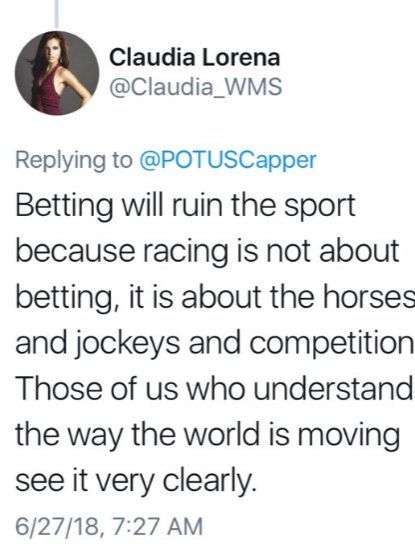
All of this serves as a preface to the since-deleted tweet that sent the handicapping section of horse racing Twitter into a frenzy Wednesday morning.
I’m going to try to frame this as delicately as possible, for any number of reasons. On a fundamental level, the content of this tweet is as wrong as wrong can be, and pretty much everyone who responded to it said as much. This is as good a time as any to cue the Richard Dreyfuss line from “Let It Ride.”
Racetracks are based on two main sources of income: Owners who buy and race their horses, and gamblers who bet on them. All of this funds the tracks, which put up purse money. Without either part of that one-two punch, tracks are doomed to fail. Saying betting will ruin the sport goes against lots of established logic, because the truth is that large-scale racing could not survive without it.
If people aren’t betting, racing cannot thrive. The question isn’t just, “How do we get racing fans to the track, or to an ADW?” The second question, which is just as important, is, “How do we provide a foundation for new fans to bet with some degree of confidence once they decide to invest their money?”
Tom knows what he’s talking about, and he’s got a lot of valid points. The problem isn’t that people are betting too much and losing sight of the other stuff. The problem is, in many ways, the exact opposite. It can be intimidating for new fans to come to the races and not have a clue what they’re looking at or how to make money.
One of the things I try to do with my DRF Formulator Angle segments, which more often than not go against likely favorites, is explain why I’m going against the grain. While much of my analysis is grounded in the numbers Formulator provides, a fair part of it deals with various parts of the form that can be spelled out. Every horseplayer has angles they’re partial to. If what I do helps one person find an angle that works for them and the way they’re comfortable wagering, that’s a win. If that person uses that angle to cash a ticket, that’s an even bigger victory.
Racing does a good job of spreading the glamorous reasons to go to the track. Having said that, what are we doing once they get there so that they keep coming back, and not just for Instagram photos? Sorry, folks: Photos in fancy outfits don’t keep the sport going. Cold, hard cash at the betting windows? That’s a different story.
(Important note: If I turn up missing in the next few days, chances are that paragraph is why!)
I attempt to bridge the information gap every day when handling DRF’s social media platforms. My goal is to make the people who see our content more aware of what’s going on so that they can consume it in the most productive way possible. Hopefully, what I’m doing is bringing content to the attention of fans who will be enriched by it. The rule of thumb I’ve always abided by is that smarter fans are better fans. If smarter fans are compelled to do more to be invested in our game (whether that’s gambling on the races or raising awareness of them), then I’ve done my job effectively.
Speaking from that experience, I think there’s more we could be doing to be more welcoming to newer fans with money to burn, and if you’re taking the time to read this, you’re part of the solution. Making new fans that are inclined to gamble is of paramount importance, and that’s something we need to do given the likelihood of legalized sports betting in the near future.
If racing does not put up a fight, the sport stands to lose significant revenue to its organized sports betting cousins that don’t have this problem. Why would a group of people bet on something they don’t understand when they’ve been watching sports their entire lives and can form justifiable opinions on them without much effort?
Contrary to a tweet that went viral Wednesday morning, we DO need gambling money, possibly now more than ever. Sharing the game and knowledge within it with someone who could benefit from it is the single most productive thing one can do.
If you’ve got insight, share it. If you’ve got advice and new players can stand to benefit from it, help them out. You were there once, and someone helped you understand what was going on. It’s your duty to return the favor, so that there’s a game for us to enjoy in the years to come.
Even though I was there, I don’t remember much about the 2008 Belmont Stakes. My main memory of that day is picking out a spot on the third level of the Belmont Park grandstand an hour before the race. The crowd began packing everyone in like sardines, and in an effort to hold my position across from the sixteenth pole, I clutched a sign advertising the section below it for dear life. It wasn’t pretty, but after a few minutes of pushing, people got the idea that I wasn’t moving.
It’s taken me 10 years, but I’ve realized that’s a heck of a metaphor for the way racing fans hold on to certain beliefs. We hold on tight, with white-knuckled grips that signify either deeply held convictions or immense fears of being wrong, but either way, when such a topic arises in conversation, we’ll speak our respective pieces as loudly as we can.
I was a college student then. I’d just finished my sophomore year at Ithaca College, and much as I had for Funny Cide and Smarty Jones, I had successfully persuaded a parent (in this case, my father) to take me to the Belmont.
I watched with baited breath as Big Brown, the easiest of winners in both the Kentucky Derby and Preakness, strolled into the starting gate. The crowd’s buzz was audible, as it had been during my prior ventures to cancelled coronations in both 2003 and 2004.
The horses settled in the starting gate, among them the undefeated Big Brown, with Hall of Fame jockey Kent Desormeaux in the irons.
The race started.
And then, an instant later, it was over.
– – – – –
I got the inspiration to write this column from a brief discussion with Desormeaux on Twitter Wednesday morning. I’d just woken up, 45 minutes before the start of my work day, and I saw that he’d retweeted something saying he was online and answering questions.
Having heard several theories on what happened that muggy Long Island afternoon, and having not yet acquired the filter that comes with consciousness, I asked if any of the conspiracy theories about that afternoon held water. Desormeaux, predictably, was not amused.
There and none. Follow the blood trail back to his barn. Do U watch ESPN quite frustrating question
There was, however, an ulterior motive to my line of questioning. If you ask a group of racing fans who the top horse of the mid to late-2000’s was, you’ll get a fair variety of responses. Many fans will say either Zenyatta or Rachel Alexandra. Some will say fellow Hall of Famer Curlin, or even Rags to Riches (the filly who edged the two-time Horse of the Year in the 2007 Belmont). Barbaro will also be fondly remembered, if only for the memories of what might have been if not for his catastrophic injury in the Preakness. Big Brown’s name likely doesn’t come up in that conversation. For various reasons, the bay son of Boundary isn’t seen as one of the best of his generation, despite wins in every single race he finished.
Much of this is undoubtedly due to the horse’s connections, which seemed to be under an interminable cloud of controversy. Big Brown was owned by IEAH Stables, which operated as horse racing’s version of a hedge fund. They had achieved considerable success with horses like 2007 turf champion Kip Deville and eventual 2008 champion sprinter Benny the Bull, but something about the enterprise did not mesh well with the racing establishment.
As the excellent Deadspin article on IEAH cited, perhaps it was the “new money” aspect of the organization that rubbed some the wrong way. What did not help the public perception of the enterprise, though, was IEAH’s trainer of choice. Rick Dutrow was one of the most gifted horsemen on the NYRA circuit, one that many feel was railroaded when he was slapped with a 10-year suspension. He was also brash, opinionated, and never afraid of a microphone, especially when the topic of conversation was one of his fastest trainees. As gifted a conditioner as he was, Dutrow did himself no favors when it came to public relations.
Horses cannot choose their connections. Many of the four-legged immortals whose form we admire were so talented that their owners and trainers were, in some way, bystanders to their brilliance, just like the rest of us. Man o’ War was that way. So was Secretariat. A case could be made for Zenyatta as well, given her personality and tendency to prance around walking rings as if she owned them (with one exception, she may as well have).
Even if he had cruised to victory in the Belmont Stakes, Big Brown would have never had that luxury. His owners were not the “happy to be there” types, nor was his trainer. A sect of the racing industry would have viewed Big Brown as the black sheep of the Triple Crown winners, horse racing’s equivalent to the cousin or uncle that never gets invited over for Thanksgiving dinner. In no way is this the fault of a supremely talented racehorse that was on the verge of greatness, but such is the legacy of Team Big Brown.
For these reasons, Big Brown has been given the short end of the stick for a decade. In no way is this more evident than when you compare the 2008 standout to a horse of more recent vintage that hit a similar wall (or, more accurately, was hit by a similar hoof) when going a mile and a half in New York.
– – – – –
The year was 2014. A California-bred of humble beginnings had taken the horse racing world by storm, and was now one Big Sandy lap away from doing what Funny Cide, Smarty Jones, and Big Brown could not.
California Chrome walked into the starting gate beneath Victor Espinoza, whose career the son of Lucky Pulpit almost singlehandedly revived. Once again, I was there. This time, I was on assignment for HRTV, and I was watching not from the grandstand, but from the Long Island Railroad platform near the top of the stretch, less than 100 yards from the HRTV trailer.
Chrome broke a bit awkwardly, but settled into what seemed like a fine trip. Turning for home, he looked like a winner, and Espinoza began pumping his arms. However, when the eventual Hall of Fame reinsman stepped on the gas pedal, he found that the tank was empty. California Chrome hung and settled for fourth behind Tonalist.
Within 24 hours, former HRTV and TVG colleague Scott Hazelton had unearthed a reason for Chrome’s flat performance. Matterhorn, a hopeless longshot in the race, had stepped on the Triple Crown hopeful out of the gate, causing a massive gash that took social media by storm. In the eyes of the racing world, California Chrome’s effort went from disappointing to borderline heroic, and followers eagerly waited to see when the fan favorite would return to the track.
He raced three more times that year. He was once again one-paced in the Pennsylvania Derby, which was unapologetically viewed by his connections as both a prep and a paid workout given the incentives offered by Parx. He then ran a strong third in the Breeders’ Cup Classic, a race marred by Bayern’s antics out of the starting gate and a non-disqualification that’s even more indefensible now than it was at the time, before cruising home in the Grade 1 Hollywood Derby on turf at Del Mar. Despite losing to Bayern twice, and despite failing to win a Grade 1 on dirt after the Preakness, California Chrome was voted the 2014 Horse of the Year.
All of this goes in stark contrast to what took place six years earlier. Big Brown was stepped on coming out of the gate by a horse named Guadalcanal, a horse for whom Joe Nevills’s “no times 17” haiku would’ve been appropriate. As Desormeaux said, ESPN followed the trail of blood all the way back to the barn. Big Brown bounced back to win twice more before being retired prior to a highly-anticipated Breeders’ Cup Classic showdown with Curlin…and yet could finish no better than third in Horse of the Year voting. Curlin had done enough to earn the trophy despite a fourth-place finish in the Classic, but the real shock was that Zenyatta, who hadn’t yet run against males, finished second. The four Grade 1 wins, two of which came in Triple Crown races, as well as a win over older horses on turf in a $500,000 race…earned Big Brown 13 first-place votes.
Why does history make Big Brown pay for the sins of his connections? Separate the horse from the humans around him, and you have one of the most brilliant horses since the turn of the millennium, one that may have been even better on turf than he was on dirt. Racing’s lineage is filled with imperfect characters of the human variety, whether any of us want to admit it or not. The way we perceive Big Brown, 10 years after his failed Triple Crown bid, reflects the ever-selective “character clause” that’s so popular in other sports. I’m of the belief that one can separate the horse from the people associated with it, and that this is the way we should approach the 2008 dual classic winner.
I’ve had my share of very unpopular opinions. I’m the guy that’s gotten hate mail from a Kentucky Derby-winning owner for having the gall to question the quality of Breeders’ Cup fields in 2012 (in my defense, my hypothesis was that most of the fields were bad, and history shows most of them were subpar when compared to previous and more recent renewals). I cashed when Zenyatta got beat, gleefully dashing to the windows to cash my Dangerous Midge-Blame double as an overwhelming majority of fans sobbed while stomping out the front door of the Saratoga harness track. Furthermore, if equine wunderkind Justify loses next weekend, there’s a chance I win big (for more on that, click here).
All of this serves as a lead-up to what I’m sure will be a hypothesis that goes over like a lead balloon. That thought: Unique Bella is nowhere near as good as many fans want her to be.
As I publish this, we’re less than 12 hours away from Unique Bella’s run in the Grade 1 Beholder Mile. She’ll be a heavy favorite over Grade 1 winners Paradise Woods and Vale Dori, and her presence has created a palpable buzz, even with much of the racing world waiting with baited breath for Justify to try a mile and a half. For this, Unique Bella and her connections must be commended. Racing needs stars, and it needs them to run as often as possible. Given her massive residual value as a broodmare, her connections could have easily retired her following her win in the Grade 1 La Brea, which was enough to earn her an Eclipse Award as the nation’s top female sprinter. They didn’t, and we as racing fans will benefit from her continued presence on the track.
That presence, by the way, is one of the reasons she’s so easy to like. If horse racing had central casting, she’d be what the agents would create. She’s a huge gray filly with a gigantic stride and an even bigger motor, which she puts on display during her ever-popular workout videos. Seeing Unique Bella on a racetrack is akin to seeing Hulk Hogan in his red and yellow, or seeing Jimi Hendrix tune up a Fender with those oversized fingers of his. It’s clear from the moment one first lays eyes on Unique Bella that she has a star quality about her many thoroughbreds simply do not have.
Here’s the thing, though. Take all of the workout videos, all of the flash, all of the fire-breathing schooling sessions, and all of the “possibly better than Songbird” buzz away, and what do you have? You have a filly that’s won a grand total of one Grade 1 race. You have a filly that got positively stomped in her lone Breeders’ Cup try. You have a filly that, yes, won an Eclipse Award, but did so in a division that was so weak by year’s end that there were few other plausible alternatives, and one that only locked up that award with a win in a race restricted to 3-year-old fillies.
As the great football coach Bill Parcells has said, you are what your record says you are. The record says Unique Bella is a very, very good horse, but nowhere near a great one yet. Don’t believe me? Let’s use a blind test against a number of other recent distaffers. This proved efficient in my piece analyzing Gio Ponti’s Hall of Fame credentials, and I’m hoping it serves its purpose once again. By doing this, we’ll test Unique Bella’s record using nuts-and-bolts data and see how she matches up.
Unique Bella
Career Record: 10-7-2-0
Earnings: $852,400
Graded Stakes Wins (Grade 1 Wins): Six (One)
Breeders’ Cup Wins (Appearances): None (One)
Horse A
Career Record: 15-13-2-0
Earnings: $4,692,000
Graded Stakes Wins (Grade 1 Wins): 12 (Nine)
Breeders’ Cup Wins (Appearances): One (Two)
Horse B
Career Record: 22-12-5-1
Earnings: $4,811,126
Graded Stakes Wins (Grade 1 Wins): 10 (Six)
Breeders’ Cup Wins (Appearances): Two (Three)
Horse C
Career Record: 8-5-1-1
Earnings: $904,980
Graded Stakes Wins (Grade 1 Wins): Three (Two)
Breeders’ Cup Wins (Appearances): None (One)
Horse D
Career Record: 16-10-3-0
Earnings: $803,068
Graded Stakes Wins (Grade 1 Wins): Four (One)
Breeders’ Cup Wins (Appearances): None (One)
If you’re a hardcore horse racing fan, you can probably guess who Horse A is. That’s Songbird. Some say it’d be unfair to compare Unique Bella to Songbird, but people were doing it before Unique Bella even ran, so this is the price that must be paid. Songbird is a no-doubt-about-it Hall of Famer when she appears on a ballot, and for as talented as Unique Bella is, she’s got a lot of going to do to match her former stablemate in the Jerry Hollendorfer barn.
Horse B is another that’s probably easy to figure out. That’s Royal Delta, whose career record looks much better if you toss her expeditions to Dubai in 2012 and 2013. When she was on her game, few were better, and she’s another that should be enshrined in Saratoga Springs sooner rather than later. Songbird and Royal Delta are what Hall of Fame mares look like. Remember this, as we’ll revisit this bar later.
Horses C and D may be a bit tougher to figure out. Horse C is, for my money, one of the most underrated horses in training right now. That’s American Gal, whose lone one-turn loss came off an eight-month layoff in this year’s Grade 1 Madison at Keeneland. Her win in the Grade 1 Test last year was explosive, and she was also impressive in winning the Grade 1 Humana Distaff last month at Churchill Downs. I genuinely believed she was the best female sprinter in the country last year when she was healthy, but I could not vote for her based on her limited body of work (I instead chose to abstain, feeling that none of the candidates did enough to merit an Eclipse). American Gal has twice as many Grade 1 wins as Unique Bella, along with higher career earnings in two less starts and one less egg-laying Breeders’ Cup performance (she was third in the 2016 Juvenile Fillies). If Unique Bella is getting the equivalent of ticker-tape parades thrown every time she breezes, where’s the love for a horse that, on paper, has accomplished more when it matters?
Horse D is another current runner, one that got her Grade 1 win earlier this year. That’s Madison winner Finley’sluckycharm. On paper, Unique Bella outshines her, but it’s not by nearly as much as you’d think, and this serves to underscore my point. We want Unique Bella to be a great horse. Some of us have tricked ourselves into thinking she’s there already. The numbers don’t say that she is.
Like any racing contrarian, deep down, a large part of me wants to be wrong. Racing needs stars in a bad way, especially if Justify retires after the Belmont Stakes (solely a hypothetical, folks; don’t get it twisted or think I have insider knowledge, because I don’t) and we’re left with a Breeders’ Cup Classic that’s, to be kind, less than marketable.
I hope Unique Bella comes out of the starting gate like a bat out of hell. I want her to channel Dr. Fager and lay down splits that grind her rivals into dust. I want her to come home with her ears pricked and Mike Smith praying he never has to choose between his latest brilliant filly and the 3-year-old that could win the Triple Crown next weekend. If she wins in 1:33 and change, and microphones pick up Smith begging Hollendorfer to keep her with fillies and mares, I’ll consider that a win for horse racing, one that it could really use.
There’s a scenario where Unique Bella wins the Beholder, the Clement Hirsch, and the Zenyatta en route to another try at Breeders’ Cup glory. Those are all Grade 1 races, and those would provide the substance her resume lacks right now. Running the table en route to the Distaff and capping the season off with a win at Churchill Downs would put her on the level of some of the great fillies and mares we’ve seen lately, as well as separate her from some of her present-day competitors that, in all actuality, she hasn’t done enough to distance herself from yet.
At that point, I’ll happily anoint Unique Bella as a superstar. To reiterate a point made by a two-time Super Bowl-winning coach, though, you are what your record says you are. Unique Bella’s record says she’s simply not there yet.
Few fans of this game want a Triple Crown more than I do. Four times between 2003 and 2014, I went to Belmont Park begging for a coronation, and four times, I left dejected.
Funny Cide left his race on the training track several days before the race and was no match for Empire Maker, a horse who may as well have been typed into the “Belmont winners” table on Wikipedia the moment Toussaud was bred to Unbridled. Smarty Jones was the victim of something that most closely resembled an ambush, one that makes this handicapper do a double-take whenever a certain jockey-turned-commentator criticizes a ride. California Chrome was stepped on coming out of the gate, but quietly ran a gigantic race in defeat. He looked like a winner up until mid-stretch, when the Cal-Bred That Could finally ran out of gas after taking the sport on the first of two wild rides he’d orchestrate. Big Brown…well, we’ll never really know what happened there, and that proved to be the first domino to fall in one of the most fascinating stories in horse racing history (this Deadspin article is required reading).
I say all of this as a preface to a statement I don’t want to make. It’s one that goes against every fiber of my being as a racing fan, which every turf writer and broadcaster still is at heart. If the below statement is wrong, I will gladly endure the mocking on Twitter that I openly spurn most of the time.
Here goes. Inhale…exhale…Justify will not win the Triple Crown.
(ducks to avoid an onslaught of tomatoes, detached chair legs, and anything else that isn’t nailed down)
Can I come up now and explain myself? OK, good.
What Justify has done to this point in his career is nothing short of phenomenal. It isn’t just that he defied the Curse of Apollo, and it’s not just that he went on to add the Preakness Stakes this past Saturday. In less than 100 days, Justify has gone from an unraced prospect to the biggest name in horse racing, winning five starts in an era where top-level horses often need that 100-day period between races for such cardinal sins as running second or third in a Grade 1.
In this era of racing, horses do not do what Justify has done over the past three-plus months. Gone are the days where 3-year-olds would run six to eight times at two, and then have four or five starts before the Triple Crown on top of that. Present-day horses are bred to be “brilliant,” often being sold for hundreds of thousands of dollars based on “breezes” of one furlong long before they’ve fully matured.
Amidst this environment, Justify has won five races, three of the Grade 1 variety and two designated as American classics. That he has done so makes him an exceptional thoroughbred. That he has done so in slightly longer than it took Phileas Fogg to circumnavigate the globe in Jules Verne’s classic novel, “Around the World in Eighty Days,” puts him in different air than even the best horses we’ve seen in recent racing history.
That journey also makes him appear very vulnerable heading into the 2018 Belmont Stakes.
The obvious reason for not being high on Justify was his run in the Preakness, where he held off Bravazo and Tenfold to win by a rapidly-diminishing half-length. Yes, he had to match strides with the talented Good Magic early, but he did so through reasonable fractions over a very fast track. Those splits were significantly slower than the ones he endured two weeks earlier, and while the final time was sharp (a shade below 1:56 for the 1 3/16-mile distance), it’s worth pointing out, yet again, that the sloppy track consistently produced fast times all day long.
Justify earned a 97 Beyer Speed Figure Saturday, a significant regression from the 103 he earned in the Kentucky Derby (which, itself, was a slight decrease from the 107 number he was given for his win in the Santa Anita Derby). A 97 Beyer Speed Figure may not be enough in three weeks against a field that figures to include several horses freshened up since the Kentucky Derby. The likes of Hofburg, Vino Rosso, and fellow WinStar Farm charge Audible could all be waiting for another shot at Justify, and after Saturday’s step back, it’s tough to say there’s any reason for any of those colts not to try again. Bravazo and Tenfold are nice horses, but Bravazo was a distant sixth in the Kentucky Derby, and Tenfold didn’t even qualify to run in that event.
Furthermore, the Belmont Stakes will be Justify’s sixth race in less than four months. On its own, that’s daunting enough. Consider this, though: Justify will be running in that race, contested at the grueling distance of 1 1/2 miles, after barely holding on over second-tier 3-year-olds going five-sixteenths of a mile shorter, all with a picture-perfect trip. There are times where you can safely assume the Belmont distance won’t be a problem for a horse. This isn’t one of those instances.
One of my best friends in the game is Joe Nevills, and prior to the Kentucky Derby, he did a piece on the average winning distances of each Derby sire. Scat Daddy ranked eighth of 14 sires, with an AWD of just under seven furlongs. Meanwhile, Tapit, who has sired the last two Belmont winners and figures to be represented by Hofburg in this year’s renewal, was second on that list, and Curlin (the sire of Vino Rosso) checked in third. On its own, it’s not necessarily a damning statistic, but given what we saw Saturday and the trials and tribulations that come with running five times since mid-February, there are serious questions about whether this undefeated star can go 12 furlongs.
I would love nothing more than to be wrong about all of this. If Justify reveals himself as a superhorse and gallops home like fellow Bob Baffert trainee American Pharoah did three years ago, that’s just fine with me. Racing needs stars, and it needs them to run consistently over long periods of time. I say this next statement without a shred of hyperbole or exaggeration: If Justify was to pull off a sweep of the Triple Crown races after being an unraced maiden less than four months prior to the Belmont, it would be one of the greatest stories in the history of the game.
Unfortunately, what I saw Saturday at the end of the Preakness wasn’t a horse being eased to the wire like one with plenty in reserve. Mike Smith’s subtle easing of Justify as he came to the wire struck me as a move made to save a few drops of gas for another taxing race in three weeks, one where the competition figures to be considerably tougher (even with the likely absence of Good Magic in mind). As a fan, I crave a Secretariat-like performance, one that puts him in horse racing’s highest pantheon of four-legged immortals that boasts a gate opened just once in the past 40 years.
If you’ve been to my site frequently since its launch in March of last year, chances are you’re aware of a feature called “War Stories,” wherein I discuss some of the random, mind-boggling things that have happened to me in my life and professional career. I’ve had a lot of fun writing those pieces, and it’s meant a lot to me that others have enjoyed reading them.
This column represents an evolution of that concept. It’s the first in a recurring series I’m calling “Champagne’s Campaigns,” which will feature some stories, a few thoughts on matters that I didn’t necessarily want to put in standalone columns, and other stray thoughts that I felt the need to put into writing. Furthermore, it provides me with another outlet to speak to the people who enjoy coming to my site and reading the content that I produce.
I’m excited to roll this out, and I’m eager to hear what you have to say. Got an idea for a future such column? Submit it using the ‘contact’ feature this site provides, or send me a tweet. If it’s good, I’ll work it into a piece. For now, here’s what we’ve got!
ON AUDIBLE, MENDELSSOHN, AND MCKINZIE MUSICAL CHAIRS
This past weekend was a big one on the road to the 2018 Kentucky Derby. All season long, we’d been waiting for a dazzling effort from a high-profile 3-year-old in a major prep race. In the span of nine hours or so, we saw two.
When Audible dropped way back down the backstretch of the Florida Derby, I was concerned. Yes, the early pace was ridiculously fast (quick enough for 99-1 shot Millionaire Runner to snatch fifth and earn $28,000 on what was basically a freeroll for his connections), but that had never been his game. However, when the field hit the far turn, there was Audible, rocketing past the field and hitting the front as they straightened for the stretch drive.
Maybe he got the perfect setup, but any 3-year-old that shows this much versatility must be respected. Todd Pletcher won the Kentucky Derby last year with a late-developing horse that was just beginning to figure things out, and he’s got a real chance to do so for the second season in a row.
Meanwhile, earlier that day, Mendelssohn overwhelmed a mediocre field to win the UAE Derby for European powerhouse trainer Aidan O’Brien. He was making his first start on dirt, but he took to the new surface like a duck to water, making the lead and kicking away on the far turn before widening away to win by an Abu Dhabi city block.
What most impressed me was his stride and way of going. He did most of the widening while on the wrong lead, but when he switched to the correct lead in mid-stretch, he found yet another gear. If there’s any flaw to speak of here, it’s that I’d be much more impressed with the effort if the Meydan surface didn’t play very kindly to early speed all meet long. However, he earned a 106 Beyer Speed Figure in that win, which is the top such number by any 3-year-old to this point in the season. He’s shipped to the U.S. effectively once already, and if he comes over in good order, look out.
Unfortunately, amidst the head-turning performances, we may have also seen a huge defection from the Run for the Roses. McKinzie, who was last seen being DQ’d from a win in the San Felipe, was ruled out of the Santa Anita Derby, where he’d have had a highly-anticipated rematch with Bolt d’Oro. With McKinzie on the shelf, Justify has been re-routed to that race, and that could also mean a re-routing of Solomini, who had been pointed to Aqueduct’s Wood Memorial but could now be headed to the Arkansas Derby.
BUNNIES, NOT BETS?
Shortly after 8 a.m. Pacific time on Sunday morning, I got woken up by a text message from my father, who still lives in New York. He had just gotten through the Gulfstream Park card, and logged on to his ADW of choice to find a reminder that residents of the state of New York were not allowed to bet on Easter Sunday.
This is ludicrous to me, on a number of counts (and yes, we’ll head into light political talk here; sorry about that). Firstly, what is a state’s government doing telling its residents that something legal 364 days of the year is somehow illegal on the 365th? Also, doesn’t this go against the whole “separation of church and state” thing that’s outlined in the First Amendment of the U.S. Constitution?
Here’s what may be the most important question: Who, exactly, is clamoring for this archaic law to stay on the books? A study by the Public Religion Research Institute published in 2016 shows that New York’s Catholic and Protestant populations are dropping, and that 25% of New Yorkers do not affiliate themselves with any religion at all (up from 17% less than a decade earlier). Why should racing fans be penalized one day out of the year with this piece of legislation, one which seems to be getting more and more outdated with each passing year given the people that reside in that area?
The NTRA’s lobbying efforts have done spectacular work of late, most notably changing the government’s federal tax code to benefit horseplayers and improve churn at the betting windows. I’m using this space to call for the NTRA to direct some of its lobbying efforts to the state of New York, and to any other states where legislation like this exists. At last check, other forms of gambling (casinos, racinos, etc.) were not targeted by this legislation, which serves no positive purpose, denies fans a chance to participate in the pari-mutuel side of the game, and cuts ADW’s off from a valuable revenue stream.
ANDREW’S DO’S AND DON’T’S OF TROLLING
As some of you know, I recently took a hardline stance against certain forms of online trolling. I can’t say for sure what set me off, but I’d seen enough from a number of people to where I decided enough was enough.
New Twitter rule for me: Constructive criticism of content I produce is fine, as is debate and conversation about it. Unmitigated bashing, especially if you use a fake name/a profile picture that is not you, doesn’t fly anymore, nor do things that get personal in nature.
Life’s too short to worry about nonsense. If you’re complaining about free content, or whining for the sake of being a troll solely because you can, do it somewhere else. Penalty for this is an instant block, plus some sort of public shaming (unless you’re begging for attention).
Like with anything else, there’s an art form to trolling people online. Certain things are acceptable, and certain things are not. Here’s a quick rundown of how to do this without making me want to put my fist through a wall.
– Put your name/likeness on what you’re tweeting. If you tweet this stuff while using a fake name and/or a picture that obviously isn’t you, you’re a gutless coward whose opinions aren’t worth the time it takes to read them. Put another way, don’t be the clown that’s tweeting behind Frosted’s name and likeness, who I had to put on blast the other day.
Observation on what could be an award-winning fight come December: It takes an awful lot of guts (read: none) to insult people when you’re not putting your real name or likeness on any of what’s written. https://t.co/V6CPpm3He9
– Pick your spots. If you’re telling me I made a bad pick when my choice runs up the track, that’s reasonable (although even the best handicappers are wrong seven out of 10 times). If you’re trying to criticize me when I’ve picked the third choice in the field and it runs third, or if I’ve given out a price that didn’t win but outran his or her odds, that’s a different story.
– Make a pick yourself once in a while. If all you use Twitter for is to bash handicappers, as opposed to contributing any content of your own, the handicappers you target will notice (and yes, we know when members of the peanut gallery make new accounts thinking their targets won’t realize it). Oddly, most of us are kindred spirits that get along with one another, and chances are we WILL laugh at you behind your back.
– Personal insults are never OK. If you want to debate handicapping philosophies, ticket construction, or any other aspect of this great game, chances are I’m all for it. If you make it personal, that crosses a line, and there’s no going back.
Follow these four simple rules, and I guarantee you that what you put forward will get a response other than, “Wow, this person’s a jerk.”
AN UNCONVENTIONAL INTERNSHIP
I’ll finish things off with a story I haven’t told yet on this site. Here’s something you probably don’t know: My career likely turns out MUCH differently if not for the presence of ESPN reporter Sal Paolantonio.
On its surface, it’s an odd link, but it’s easily explained. Several of his children attended Ithaca College, and I was fortunate enough to interview him on a radio broadcast my senior year. He treated every college student he came across warmly and with tremendous respect, and he also won favor with all of us by driving our collective arch-nemesis, the sports information director nobody liked (read this for more information on why), absolutely bonkers simply by coming to the press box.
Sal took an interest in me, and he was friendly with Merrill Reese, the radio play-by-play man for the Philadelphia Eagles (and another one of the good guys). In addition to those duties, Merrill runs WBCB, a community radio station in Levittown, Pa., a small city northeast of Philadelphia (near Trenton, N.J.). Because of my ties to Sal, I landed an internship there in the summer of 2010.
In my time there, I did commercial spots, conducted a few interviews, assisted with promotions, rubbed shoulders with some really cool/talented people (shout out to Paul, Mike, Matt, Steve, Dan, Cassandra, and Wendy, among others!) and helped out with a Wednesday night sports show called “The Second Shift.” Most notably, though, I got to call regional play of that year’s Little League World Series, which was much less of a drive for me to get to than for the rest of the staff since it took place in Connecticut. My work there was part of what got me hired at Siena College, which in turn led to my job at The Saratogian, which in turn opened doors at HRTV, TVG, and The Daily Racing Form. That first door got opened in large part because Sal put in a good word for me, and I’ll always be grateful to him for that. Sal, if you’re out there: Thanks.
The internship was a blast, but there was a catch: It was a three-hour drive from my then-hometown! This meant waking up early once or twice a week, heading down the highway, and doing the same drive in reverse at night. The quickest way home took me down State Route 206 in New Jersey, which leads to I-287 and the New York State Thruway. If you’re not familiar, 206 goes through a lot of the state’s richest suburbs. These suburbs had police departments that did not exactly take kindly to old, cheap cars with out-of-state plates on them rolling through in the dead of night, as I’ll explain.
It’s just before midnight, and I’m driving on 206 through Hillsborough, N.J., which is just north of Princeton. Suddenly, a local cop gets on my tail, and he starts doing a few tricks to try to throw me off. He rides my back bumper, drops way back, and then creeps back up, trying to see how I’ll react. We get to a red light after several minutes, and I say to myself, “OK, he’s either going to blow past me, or his lights are going on and he’s pulling me over.”
Sure enough, lights and sirens come on, and he pulls me over. He asks for my license and registration, asks what I’m doing there…and then starts asking me about narcotics. Yes, folks, apparently in order for this cop working the graveyard shift to meet his quota, I was expected to fill the role of a suspected drug mule for doing nothing more than driving through town with New York plates on a 1998 Mercury Sable.
Quickly, he realizes this is going nowhere, and he busts out his flashlight. In scanning my car for drug paraphernalia that does not exist, he notices two cards of DRF past performances in my front seat. He asks if I’m a gambler, to which I respond that I’m heading to Saratoga twice later that week (once with my dad, once with my mom). Disgusted and disappointed, the cop mutters, “Well, good luck,” bolts to his car, and before I can even digest the situation, he’s gone off to bug someone else.
I’ve been lucky enough to do a lot of interesting things in my career, but that experience was among the weirdest ones I’ve ever been through. I’m a 21-year-old kid just trying to get home from work (albeit with a ridiculously long commute), and now I need to worry about local cops pulling me over just because they can? I loved my internship, and, as mentioned, it did a lot of good, but let’s just say I found a different way home after that!

 Andrew Champagne