An Airing Of Horse Racing Grievances

This week, for the first time in a while, I talked about the health of horse racing and didn’t like what I saw or how I felt after I did it.

In fact, it happened twice, and I’m not sure what to do about it.

Unfortunately, the state this game is in right now isn’t a good one. Cards in the northeast are being cancelled left, right, and center due to weather (in some instances, weather they’d have run in in the past). Woodbine’s closing day program was abandoned midway through the card, with doubts raised over mandatory-payout wagers. Hastings Park in Canada, meanwhile, announced its immediate cessation of racing after British Columbia decided to stop subsidizing racing with slot revenue, and on a related note, The Stronach Group is gearing up for the second round of a fight to decouple horse racing and slots in Florida.

I’d love to be optimistic, but given the circumstances, it’s hard to find silver linings. Because of that, this was the podcast that resulted over on the On the Wrong Lead network…

I don’t like being negative. In fact, I pride myself on being a realist whose content generally ticks people on both sides of any issue off in equal measure. I’ve found that’s a good doctrine of fairness.

(Writer’s note: There are also the people who get ticked off at my mere existence, and that’s a separate issue. I enjoy pushing the buttons of those people because, hate me or love me, you engage with my content and that’s all one can do.)

(Editor’s addition: Remember, boys and girls, that the opposite of love isn’t hate, it’s indifference.)

(Writer’s addition to the addition: Some folks never learned that lesson, and it shows.)

I don’t want to see horse racing decline, wither, and die. I want to see it thrive, and I’ve actively spent time and energy figuring out ways the industry can do this. Everything I have, I owe to this game and a few people in it who cracked the door open for me, allowed me to do a lot, and gave me the chance to build my career.

Very little of what’s happening now, though, inspires confidence. In addition to the track-related factors above, bettors will soon be taxed on some of their losses, which will undoubtedly chase away some of the sport’s highest-handle players. Many within the gambling industry are lobbying to change this after harsh initial outcry, but that will take significant bipartisan cooperation on at least one piece of legislation within the U.S. House of Representatives and Senate (two chambers…not exactly known for working well together of late).

The annual racing symposium at the University of Arizona, meanwhile, had some real head-scratchers. Craig Milkowski has been a friend of mine for more than 20 years, ever since I was posting to the PaceAdvantage board as an underage player. I love him, but I’d like nothing more than a world where the symposium doesn’t have to do a panel on timing races, one where tracks can start and stop watches at appropriate times (you know, the way every other serious sport in the world does). The CAW panel was what it was. Panels on attracting sports betting crossover had the same empty verbiage we’ve seen for years on end. Everyone seems to agree some sort of change is necessary, but beyond that, the stakeholders involved don’t seem to agree on anything else.

I really want to be positive about this game, the one that, at its best, is the best gambling game around. With all of that taken into account, though…wouldn’t that be delusional?

The show went live earlier this week. On Thursday, another piece of news broke involving Saratoga. That track will host a total of 51 racing days in 2026, between the five-day Belmont Stakes Racing Festival, several extra days in early-July, and the 40 days we’ve come to expect at the Spa.

I feel like it’s too much. I tweeted as such (along with a few things designed to push buttons of the “ticked off at my mere existence” people, and BOY, did that work!), and it sparked a lot of conversation. It’s true that 2026 is the last summer before the opening of the new, renovated Belmont Park, which is set to open its doors in September. Having said that, Saratoga has seen days creep up from 24, to 30, to 36, to 40, and now all the way to 51. What was once “the August place to be,” I’d argue, won’t even qualify as a boutique meet next year.

Last year’s calendar was similar, and the effects were far-reaching. Sovereignty won the Travers, we rolled into the week leading up to Labor Day, and all of a sudden, the track looked and felt dead. What came through my television screen wasn’t just a lower-key atmosphere, but one where people looked like zombies because the energy seemed to be flat-out gone. Everything that doesn’t happen often has a saturation point where, once you pass it, it’s not as special anymore. Saratoga found it last year, and it feels like we’re set to pass it again in 2026.

With that, we come back to what I outlined at the start of this article. I wouldn’t be what I am today, professionally or personally, without this game and the opportunities it’s given me. I don’t want to be seen as overly-negative. I don’t want to feel badly about what’s going on in the sport, and I want to be in a position to celebrate the good in it.

However, let’s be honest with ourselves: There just isn’t much positivity to celebrate right now. I don’t know what any of us can do other than call a spade a spade and keep hoping the ship gets righted…but what confidence do we have that those in power can and will make the correct calls to do so?

I’m asking. I wish I had the ability to answer these questions. I don’t, and it bothers me.
No Fairs? Not Fair.

The Kubler-Ross model says there are five stages of grief, with acceptance serving as the final one.

When horse racing is involved, I’d argue the model is backwards. It’s very, very easy to accept a beloved circuit or institution dying because that’s what we’ve been conditioned to expect.

The latest toll of the bell came for the Northern California racing fairs. Long prominent parts of the summer and fall calendar, seasons at Pleasanton, Sacramento, Ferndale, and Fresno will not be conducted by the California Authority of Racing Fairs in 2025.

This announcement, which came Tuesday, was predictable. The Golden State Racing fall meet at Pleasanton didn’t come close to meeting the numbers put up by Golden Gate Fields, which was shuttered by The Stronach Group (more on them later) in June of 2024. Golden State Racing declined to apply for dates in early-2025, and even though Pleasanton still operates as a training center (for the moment), many horses and horsepeople went elsewhere.

The ability to see this news coming, however, doesn’t make it any less painful.

I wrote about the fair circuit being a breath of fresh air last month. I started freelancing in Pleasanton in 2019, and have co-hosted handicapping seminars outside the grandstand for the past several summers. The crowds were kind, the people who worked at the track busted their butts, and the atmosphere blending racing fans with families enjoying everything the fair had to offer was as pleasant as I’ve ever experienced at a horse racing venue.

When Golden Gate Fields closed, the fairs put forth a plan to house year-round racing at Pleasanton. The Stronach Group, which had never been a fan of CARF to begin with, responded by threatening to sell Santa Anita. Apparently, if they didn’t want to conduct racing in Northern California, nobody else should’ve been allowed to do so, either.

Objectively, this entire scenario did not have to happen. Golden Gate Fields may not have been an “A track,” but it generated roughly $3 million in handle per day. The land it sits on is valuable, yes, but it occupies parts of Berkeley and Albany, which makes selling and repurposing it very difficult for zoning purposes. One can’t simply buy the land, tear down the track, and build high-priced condos, but that didn’t stop The Stronach Group from putting these events into motion and trying to close as early as December of 2023.

The theory was that California could no longer support two circuits, and gathering all horses in Southern California would boost the product at Santa Anita. A bit more than a month after Pleasanton’s final race, we can deduce this never held water. Santa Anita’s product is still struggling, and Northern California horses, which had been running against slower stock, have mostly been non-factors in races against their SoCal counterparts. Plans to add an extra day of racing each week and capitalize on an increased headcount of horses have yet to come to fruition, and Northern California horsepeople are, predictably, bitter about promises they say haven’t been kept by the state racing industry’s governing bodies.

This is preferable to the previous status quo…how, exactly? This has hurt a lot of good people, from NorCal racing fans left without a circuit to follow to horsepeople that now have to ply their trades on other circuits (some of which aren’t exactly on stable ground, either). Golden Gate Fields wasn’t on life support, and neither were the fairs. Northern California horse racing didn’t pass away of natural causes. It was murdered.

The Stronach Group’s own tracks have their issues, of course. In a highly-publicized disaster in the making, Gulfstream Park’s horsepeople are being strong-armed into backing decoupling legislation, with only the vague, unwritten promise of support to keep racing at the property going into 2028. In an interview on Pegasus Day, Belinda Stronach said that having racing in an urban environment was not ideal.

(The presence of dozens of other tracks worldwide in major cities would seem to act as an ideal fact-check. However, it doesn’t seem like that matters much to her at the moment.)

Meanwhile, other circuits seem to be hanging by threads. Arizona’s sole operating track, Turf Paradise, battles rumors of closing every few years. Texas horse racing cut back its purses and total race count significantly after several years of resistance against HISA (and, by extension, several years of out-of-state American players not being able to bet on the product). Even New York, which boasts a stable industry, has condensed from three tracks to two and will close Aqueduct when the new Belmont Park opens in 2026.

Again, though, the grim reaper’s ability to come for tracks at any moment is something we’re apparently just supposed to accept, as is the lack of accountability for those who have forced the sport into these situations. We accept this because there’s no alternative we can pursue. We’re supposed to cry for a bit and then, to steal a phrase from the horse racing Twitter crowd, shut up and bet.

In something that, I’m sure, will surprise no one (from the degenerates who think I’m a suit, to the suits who think I’m a degenerate), there’s no shutting up happening here. The fairs didn’t have to die. Unnecessary turmoil, gross mismanagement within the industry, and petty politics took away a source of joy for so many people, not to mention one of the lowest “barriers to entry” at any horse racing venue in the country.

Acceptance is easy, because given those involved in this saga, a terrible end was predictable. The second step of that “five stages of grief” model, however, is anger. That’s the stage that will be toughest to get past.

The Sign, And Signs Of The Times

Golden Gate Fields had its second dispersal auction not long ago. The Northern California track closed its doors in June and had an initial auction in the fall, but there were enough leftovers to justify a second go-round.

The first auction didn’t go well for me. I got outbid for everything but several sets of glasses celebrating renewals of the Kentucky Derby and Santa Anita Handicap. This time around, though, there was an item I simply had to have.

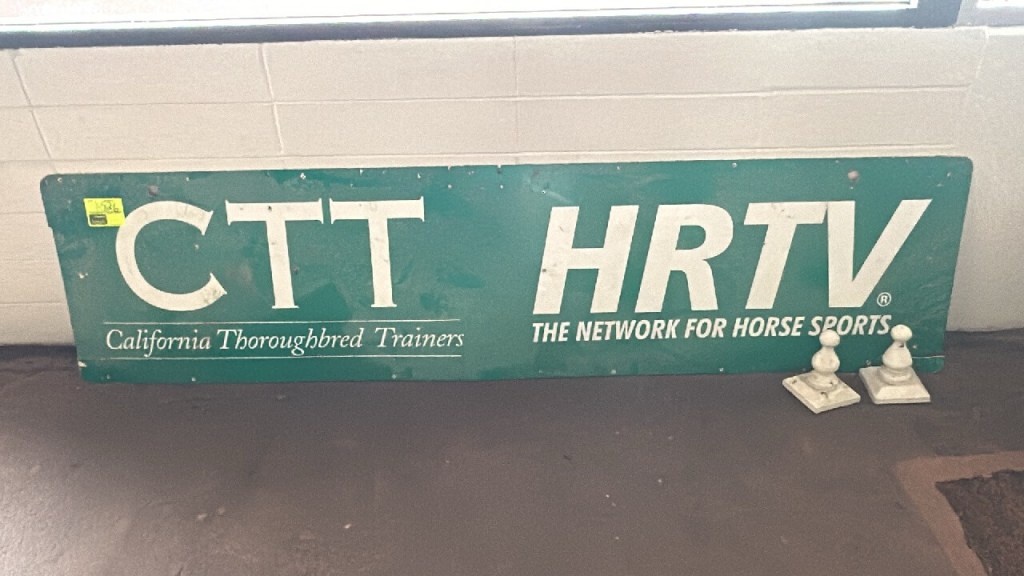
Up for bids was a green sign that included four white, magical letters representing the TV network that launched my career. To me, they represent a much happier, more innocent time in the game.

The sign brandishing the HRTV logo now resides in my office/guest room. And it’s brought up a lot of nostalgia, especially over the past few days.

We’ll get back to that, but first, it’s time for a trip down Memory Lane…

– – – – –

I desperately needed a reset (for both personal and professional reasons) in the late-summer and early-fall months of 2013. On a whim, I sent my resume to HRTV, and a few weeks later, I interviewed for a job on their digital media team. It went well, and in October, my dad and I stuffed my Chevy Impala with everything it could hold and drove it cross-country.

A lot of things changed over the next year and a half. I met the woman I’m going to marry next year, I worked with some incredibly smart people, and I did plenty of things I’m very proud of. I’ve told a few of these stories elsewhere, and you may have seen them, but they’re worth telling again.

Jeff Siegel and Aaron Vercruysse were some of the best allies one could ask for. They gave me opportunities to help them with a lot of HRTV’s “over-the-top” coverage. With the approval of my then-supervisor, Phil Kubel, these “Santa Anita Uncut” and “HRTV Extra” broadcasts helped establish the blueprint for the streams you see on YouTube, Twitch, and other social media outlets today. I’m forever grateful to them for that, and, in one particular instance, for going to bat for me when they didn’t have to (that’s a story for a much, much different time).

I helped Jeff with a stream from the 2014 Belmont Stakes, when California Chrome went for the Triple Crown. At some point that week, I found myself in the HRTV trailer with Caton Bredar, who I’d only met a few times before then. She smiled at me and said, “are you trying to steal our jobs? You were really good!” I’ll never forget that.

The team, as a whole, was one of the most talented I’ve ever been on, and not just in live production. The folks who put together the “Inside Information” documentary series did brilliant work telling some of the sport’s most interesting stories, including ones that were off the beaten path. In particular, the one discussing the Saratoga WarHorse Foundation was an all-timer, and it’s an absolute shame most of the documentaries in that series aren’t accessible online in some form or fashion anymore.

(Paging anyone with access, either at FanDuel TV or XBTV: Can we rectify this somehow? That’s a VERY easy way to get quality programming out there!)

I remember Millie Ball establishing herself as one of the toughest people I’ve ever met just by showing up. Her husband, Tim Yakteen, trained 2013 Breeders’ Cup Sprint contender Pointsoffthebench, a horse that suffered a fatal injury training for the race. It was a terrible breakdown, and nobody would’ve blamed Millie for going home. Instead, just a few hours later, “Race Day America” went live with Millie sitting next to Peter Lurie, and she gutted it out on the air.

I also remember one of the all-time great pivots in the history of sports television. Gulfstream Park had scheduled a mandatory payout of the Rainbow Six jackpot pool. Officials anticipated a final pot of more than $20 million, and HRTV’s programming included extensive analysis of that sequence.

There was just one problem: Dan Borislow etched his name in the handicapping history books by scooping that pot the day before the big one (to this day, horse racing Twitter refers to a jackpot hit right before a mandatory-payout day as a “Borislow”). This, of course, meant that Gulfstream Park missed out on a record-breaking handle day. It also meant that a TV network owned by the same parent company needed to alter its programming on the fly!

They somehow got Borislow on the phone while Kurt Hoover was on the desk. Kurt’s a pro’s pro who still does a fantastic job on FanDuel TV and FanDuel Racing, but he got a bit frustrated when Borislow didn’t seem to understand a question about the construction of his ticket. The lucky handicapper finally got the message and said something to the effect of, “that’s a great question!”

“Yeah,” I remember an annoyed Kurt saying, “that’s why I asked it twice!!!”

Horse racing makes it hard to be a fan sometimes. For the most part, HRTV made it easy.

– – – – –

HRTV was purchased by the company then known as Betfair in early-2015. To Betfair’s eternal credit, they hired many more HRTV employees than any of us thought they would. I wound up there for a bit more than two years.

(My first two years there were fabulous. It took quite a while, but my last two months were avenged by karma earlier this year.)

After a stop at The Daily Racing Form, my full-time work ceased to be in the horse racing business in late-2018. I still, of course, do quite a bit of freelance work in the industry with outlets like the Hong Kong Jockey Club, The Paulick Report, and The Saratogian, and that, combined with a full-time job elsewhere in the gambling world, is enough to keep me happy.

One other freelance assignment I’ve had materialized after I moved to Northern California. The NorCal fair circuit’s then-announcer, Chris Griffin, was looking for guests to help with handicapping seminars at Pleasanton’s Alameda County Fair. I responded, one thing led to another, and I’ve spent part of the last several summers on stage offering my analysis and selections.

The fair circuit was a breath of fresh air. I love tracks like Saratoga and Santa Anita, but they’ve housed plenty of extraordinary races where one could hear a pin drop on the apron. If it’s a nice day at Pleasanton and a field of $2,500 claimers spins into the stretch with each horse having a shot, the entire grandstand starts roaring.

I was on-site for Pleasanton Mile Day in 2023. It was the first-ever renewal of that race, and it was the richest event in North America that day. The weather cooperated, the track’s apron was jammed, and I couldn’t help but repeat the same axiom a few different times, to a few different people.

“A lot of places make it hard to be a racing fan sometimes. This place makes it easy.”

A few weeks after that day, a bunch of NorCal power players were in Sacramento for a charity poker tournament benefiting autism awareness efforts. A “breaking news” article by the LA Times’s John Cherwa dropped a bombshell: The Stronach Group (or TSG, as I’ll refer to them going forward) was pulling the plug on racing at Golden Gate Fields.

This was a Sunday afternoon. A few prominent people got about five minutes’ notice. Many got none.

The way this was communicated was unforgivable, and efforts to half-apologize during subsequent meetings and conference calls did not go over well. Ultimately, Golden Gate Fields ran a bit longer than TSG desired, closing in June of 2024 instead of December of 2023.

In an effort to fill the void, the fair circuit unified as Golden State Racing and proposed a new year-round Northern California circuit located at the fair tracks. TSG, predictably, was dead-set against this idea and, in response, floated a possible sale of Santa Anita Park.

To say that wasn’t well-received would be an understatement. TSG’s Craig Fravel, who has since left that company, was skewered over the threat at a mid-year CHRB meeting. Golden State Racing didn’t just get fall dates. It won them with unanimous approval.

I was there a few times during the fall meet, which will officially conclude Wednesday. Most notably, I guest-hosted the simulcast feed on Breeders’ Cup Saturday (combined with that night’s Sha Tin card, it made me, I believe, the first person to appear on two simulcast feeds, across two continents, on the same day; that’s a cool legacy to have!). It wasn’t the same as during the fair, when families popped in and out between going on rides and sampling fried food, but it was fun, and people wanted it to work.

News broke Monday, however, that Pleasanton will not run dates prior to next summer’s fair season. This leaves Northern California without a full-time circuit, and depending on how many horses stick around, the fair racing season encompassing stops in Pleasanton, Sacramento, Santa Rosa, Ferndale, and Fresno from June to October may be in doubt, too.

There’s no way this doesn’t stink. Fans in NorCal don’t have a full-time circuit to follow. Horsepeople need to make tough decisions, even if TSG makes good on plans to shuttle horses downstate. Will Santa Anita run lower-level claiming races than they’ve ever run at the Great Race Place? Will they offer races restricted to NorCal shippers? Or will their stock be forced to sink or swim against that of SoCal supertrainers who have consolidated most of the circuit’s fastest horses into a few select barns?

We don’t know these answers yet. However, these come from tough conversations the industry has shown it doesn’t want to have. If you’re not optimistic about this, I can’t say I blame you.

– – – – –

This brings us back to the sign. It’s the one that hung from the inside rail near the wire at Golden Gate for several years, and in addition to advertising HRTV, it also contains the logo of California Thoroughbred Trainers, which still shows its NorCal headquarters as Golden Gate Fields.

I won it at auction for $25, and I picked it up earlier this month. After being directed up the track apron by a lonely security guard, I parked across from the track’s main video board and took a look around.

The track’s Tapeta surface had been scraped up and plowed to the side, moreso resembling a brown snow bank than anything else. The infield’s grass wasn’t a pretty sight, the flags had long ago been removed, and the track that, just three years ago, saw eventual Preakness winner Rombauer capture the El Camino Real Derby was hauntingly quiet.

I picked up my sign, as well as a framed picture of a jockey covered in mud. The sign had a few cracks from being moved around, and I’m sure those didn’t get better as I figured out how to fit it into my Hyundai Sonata. I finally succeeded, bringing something that reminded me of such joy out of a place that reminded me of the very real hardships facing the industry at the moment.

Golden Gate’s gone. The NorCal fair tracks may follow suit. In addition, these events don’t necessarily ensure the survival of the SoCal circuit. Even if there’s no NorCal circuit to compete with, horses still aren’t being bred the way they once were, the horses that are bred still don’t run as much, and more lucrative racing options exist in other states.

Everything that’s happened in California makes it harder to be a horse racing fan.

I miss the days, the places, and the people that made it easy.

Justify, The Hall Of Fame, Historical Context, And A Hard Answer

Earlier this week, the National Museum of Racing and Hall of Fame announced its 17 voting finalists for its 2024 class. Those with a vote (self included) will receive ballots soon, and the top vote-getters will be enshrined in Saratoga Springs this summer.

The most polarizing name on the list is Justify. Acting as though this is straightforward either way is naive at best and biased at worst, and when I tweeted that I had absolutely no idea what I was going to do with him, I wasn’t blowing smoke.

What do writers do when things get puzzling? We write through it. With that in mind, let’s discuss the 2018 Horse of the Year and a fascinating question: Is Justify a Hall of Famer?

– – – – –

It makes sense to start with a primer on why we’re here. The case for Justify is quite simple and can be summed up in four words: Undefeated Triple Crown winner.

Justify didn’t make a single start as a 2-year-old. Instead, he broke his maiden at first asking in January, won an allowance race, beat Bolt d’Oro to the wire in the Santa Anita Derby (more on that later), and became the 13th horse to sweep America’s three marquee races for 3-year-olds (and just the second since Affirmed did it 40 years earlier).

He was retired a few months after the Belmont Stakes, and a mild Horse of the Year debate ensued when Accelerate rampaged through California’s biggest races for older horses and annexed the Breeders’ Cup Classic. Before any member of the ever-present Bob Baffert fan club goes after me, I want it noted that I strongly believed Justify was the easy Horse of the Year choice (and wrote about it on this very website).

Most voters agreed. Justify won the trophy and went off to the breeding shed. However, in the past few years, new details have come to light about a positive drug test that came after the Santa Anita Derby. The California Horse Racing Board opted not to disqualify him due to environmental contamination, but in December of 2023 (nearly six years after the race), the Los Angeles County Superior Court ordered the CHRB to set aside their ruling, DQ Justify, and install Bolt d’Oro as the race’s winner.

Without the Kentucky Derby points he earned in the Santa Anita Derby, Justify would not have made the field on the first Saturday in May. Churchill Downs has said it has no plans to alter the results of the 2018 Kentucky Derby, but it’s not illogical to wonder if he should have been in the gate.

Additionally, Justify retired after the Belmont and never faced older horses. Not running in races such as the Breeders’ Cup Classic opened the door for another runner to be considered, by some, a viable threat for Horse of the Year, and in an age where horses don’t run as much, a longer career would have certainly been more appreciated by some in the voting bloc.

– – – – –

To try to make some sense of this, I dove into the history books. On Tuesday, I asked if any Hall of Fame horse carried as much “baggage” as Justify. When in doubt, some degree of precedent helps, and I wanted to see if there were any comparable situations.

The answer: Not really. A couple of horses went through strange situations before being immortalized. Grey Lag raced at age 13 against claimers after falling into the wrong hands. Bewitch’s signature win as a 2-year-old, over Calumet Farm stablemates Citation and Free America, may not have been entirely on the level. Safely Kept may not have made it into the Hall of Fame had Dayjur not jumped a shadow late in the 1990 Breeders’ Cup Sprint. Unfortunately, that list also includes Exceller, who was enshrined in 1999 (two years after being sent to the slaughterhouse).

Those stories, though, are pretty different from the one Justify carries, so no dice there. I was, however, able to find a few answers to the “never faced older horses” question.

For the most part, horses enshrined in the Hall of Fame have some longevity to them. However, Justify would be far from the first horse to go in having never faced older rivals. I count at least five honored horses who share that distinction. That list includes another Bob Baffert trainee, Point Given, as well as Tim Tam, Count Fleet, Colin, and, sadly, the ill-fated Ruffian.

That list mainly features horses who suffered career-ending injuries. Justify did require time off, but probably could have continued racing as a 4-year-old. However, as I’ve discussed time and time again on various platforms, the breeding industry is the tail that wags the dog in racing, and there was simply much more guaranteed money to be made sending Justify to stud.

(One quick note: I’m seeing some pro-Justify people support his case by mentioning his early success as a sire. One’s breeding career should have absolutely nothing to do with a Hall of Fame case. The Hall of Fame is for what happens from the starting gate to the wire, not for the results of activities in the breeding shed. Please stop.)

I’m fairly old-school. I like when horses run for long periods of time and do so at racing’s top level. Having said that, while Justify’s short career isn’t ideal, I also can’t hold it against him too much. Add in the likelihood of fellow six-time starter Flightline being a first-ballot Hall of Famer in a few years, and it’s entirely possible longevity just doesn’t matter much anymore.

– – – – –

A unique convergence of events makes this one of the weirdest Hall of Fame questions since the institution opened its doors in the 1950’s. Bob Baffert, of course, has dealt with multiple high-profile positive drug tests. In addition to Justify, a drug test on initial 2021 Kentucky Derby winner Medina Spirit showed betamethasone, and Gamine was disqualified from a third-place finish in the 2020 Kentucky Oaks due to the presence of that same substance.

Baffert is in the Hall of Fame. In addition to Point Given, other former Baffert trainees such as Arrogate, American Pharoah, Silverbulletday, and Silver Charm all have plaques in Saratoga, too.

To call the situation awkward would be an understatement. Nothing about this feels particularly clean. A “yes” vote seems ignorant of an awful lot of facts. A “no” vote…also seems ignorant of an awful lot of facts.

In the absence of much precedent (other than “a few horses with short careers are in”), I keep coming back to the decision made by Churchill Downs. That entity, which has made zero friends in the Baffert camp over the last several years, has opted not to revisit the results of the 2018 Kentucky Derby. Given everything that’s happened since Medina Spirit crossed the wire first in 2021, CDI doing that would have been far from shocking.

Without that race on Justify’s resume, he’s almost certainly not a Hall of Famer (perhaps that incentivizes his connections to run the horse as a 4-year-old, but that’s strictly hypothetical). It being there, however, pushes Justify to a level of rarified air. The previous 12 Triple Crown winners are all enshrined in the Hall of Fame. Only one, Seattle Slew, was also undefeated when he pulled it off.

No, it’s not pretty.

No, it’s not an easy decision.

No, anyone involved in the nearly-six-years-long process to figure out what happened with the post-Santa Anita Derby positive test, and how it should affect the result of the race, should not be involved in such a decision, at all, ever again.

Yes, Justify is a Hall of Famer.

No, Kentucky Derby 150 Doesn’t Need An Asterisk

This past weekend, Nysos won the Robert Lewis Stakes at Santa Anita, and he did so very impressively. In the process, he moved his career record to a perfect 3-for-3. That effort, combined with an underwhelming showing from Fierceness in the Holy Bull at Gulfstream Park, made many think he’s the top 3-year-old in the country.

Nysos, though, won’t run in the Kentucky Derby. He’s trained by Bob Baffert, who also conditions several other top-class 3-year-olds. Baffert’s Kentucky Derby ban has been extended through this year’s renewal, and unlike the past two seasons, owners connected with those horses decided to keep their runners in the same barn.

Outcry has, predictably, been pretty harsh, and not just from the usual suspects on horse racing Twitter. Several journalists I respect a great deal have chimed in, claiming that this year’s Kentucky Derby has a stain on it from the lack of Bob Baffert trainees (several of which would be considered logical contenders).

As you can probably guess from the headline, I don’t agree with that sentiment. However, my thoughts on this are similar to the ones I had about the Alix Earle situation at the Pegasus World Cup: Many people have this very, very wrong.

I’m going to throw my readers a curveball here with this next sentence (at least in the eyes of some who will see this article): I don’t love the way Baffert was suspended an additional year. The precedent of tacking on additional time after a verdict was handed down, and as a punishment is being served, isn’t a good one.

The long-running legal battle between Churchill Downs and the Baffert/Amr Zedan camp undoubtedly played a role in this. It was ugly, and I think most of the racing world breathed a sigh of relief when Baffert and Zedan stopped pursuing the case earlier this year. I understand CDI doing what it feels is best for business, but it’s also logical to think this stacks the deck against someone who may have a legitimate case of some sort down the line.

Acting as though one person or one entity is above the game is misleading, at best. On the other hand, though…acting as though one person or one entity is above the game is misleading, at best. Much like Churchill Downs, Bob Baffert and his owners aren’t more important than the rest of the industry.

Owners of horses like Nysos had a choice. They could’ve gone the routes made popular in 2022 and 2023 and sent their Derby prospects to the barns of Tim Yakteen, Sean McCarthy, Rodolphe Brisset, Brittany Russell, or other trainers in the game. More than one trainer can condition top-tier animals. Those owners chose to go another route, and that’s their right. I won’t criticize them for doing what they feel is correct. They pay the bills, not me.

What I also won’t do, though, is act as though those people are victims. Baffert was blackballed from the Run for the Roses, not the owners. Just because those connections aren’t pointing those horses to the Kentucky Derby doesn’t mean I’m going to devalue that race, and I don’t think anyone else should, either.

Barring a flip-flop by the owners of horses like Nysos, Muth, and others, those thoroughbreds won’t be in the starting gate. That’s not ideal, and neither is acting as though everything’s fine and the efforts of those horses don’t exist (as Churchill’s doing). However, it’s not the first time horses at or near the head of the class won’t go postward on the first Saturday in May.

Horses get knocked off the Derby trail every single season. Injuries derail the chances of major players frequently. Most notably, Forte, who would’ve been favored a year ago, scratched the morning of the race. Life Is Good and Shared Belief sure would’ve made the 2021 and 2014 Derbies more interesting, too. They didn’t run, either, and both years, fans and handicappers more than made due on the first Saturday in May.

The difference, of course, is that Nysos isn’t injured. As far as we can tell, he bounced out of the Lewis well. We’ll probably see him in either the San Felipe or the Santa Anita Derby, depending on what Baffert decides to do with his other 3-year-olds, and wherever he winds up, he’ll almost certainly be a very heavy favorite (and justifiably so).

Yes, the Kentucky Derby would be better with Nysos in it. Yes, the Preakness sure looks like the Bob Baffert Invitational, where that barn will undoubtedly be loaded and ready to feast upon horses being wheeled back in two weeks and other “new shooters” that almost certainly don’t stack up well in the form. Saying otherwise is naive and acts as though a major issue doesn’t exist (which, to be fair, is in line with horse racing’s approach on other topics that it’s kicked the can down the road on and can no longer just ignore).

However, there’s a lot of blame to go around for the way this wound up. Giving the race a physical or mental asterisk solves nothing. I’ll never agree with those acting as though the Derby is somehow just another 3-year-old race because one trainer, and owners who made conscious choices to stick with that trainer, can’t participate.

(As an aside, an acquaintance of mine has said they’re taking screenshots of folks insisting they don’t care, won’t bet on the race, and making other bold statements. I look forward to the “then and now” posts made when those people inevitably cave.)

It gets old saying “everyone’s wrong.” I genuinely believe most people mean well. I don’t think anyone’s happy horse racing is in the shape it’s in right now. These conflicts, though, solve absolutely nothing and make unifying for meaningful change beyond one big day much, much harder.

Here’s hoping that stops, and does so sooner rather than later.