THE DARK DAY FILES: Justify, Social Media, Bad Behavior, and a Challenge

In an age where it seems like the only people who get attention on social media are the ones with the loudest, knee-jerk reactions to hot-button issues and breaking news, I prefer to take a contrarian approach. This is why I’ve waited a week to offer my thoughts on the retirement and legacy of Justify, who, to the surprise of very few, has seen his racing days come to an end.

I’ll keep my thoughts on Justify pretty brief, as there’s a much bigger issue I feel the need to tackle (more on that later). The words “undefeated Triple Crown winner” have only ever been uttered once before this year, and it was when Seattle Slew finished off a nine-race win streak in the Belmont. Slew, of course, came back to run as a 4-year-old, when he treated the racing world to several battles with the likes of Affirmed and Exceller, and in fact lost his very first start after the Belmont (in the Swaps Stakes at Hollywood Park).

Justify won’t get the chance to race into his physical prime. Instead, we must settle for horse racing’s version of a firework, materializing into something brilliant with rarely-matched flair and disappearing just as quickly as it arrived. Would racing have benefited from Justify running a few more times? Of course, but this is a horse that had nothing left to prove. “Undefeated Triple Crown winner” is as powerful a resume as an equine specimen can possess, and in a year where, to be blunt, the handicap division leaves much to be desired, there is no dirt horse Justify could’ve conceivably run against and beaten that would have enhanced his legacy.

As a voter for both Eclipse Awards and racing’s Hall of Fame, I can unequivocally say these three things.

1) Justify is Champion 3-Year-Old Male.
2) Justify is the Horse of the Year.
3) Justify is a first-ballot Hall of Famer.

With all due respect to the likes of Accelerate, Monomoy Girl, and others, “undefeated Triple Crown winner” is not a resume any other thoroughbred can top. Some may have a problem with him never facing older horses. I don’t.

This is where, unfortunately, my column takes a pretty sharp turn. If you’ve followed me on Twitter, you know that there have been a few instances where I’ve denounced the culture horse racing “fans” have created on social media. I put the word fans in quotation marks there because, in my opinion, if you’re not actively working to make the game better or more enjoyable for those who may see your content, you’re doing nothing productive, and you’re not a true fan.

At its peak, social media is a godsend. It’s a way to communicate with friends and loved ones, as well as a way to stay updated with regard to breaking news. I’ve made my career as a digital media professional for several different outlets, and I can attest to a number of times where the things social media allowed my employer(s) and I to do made for some pretty cool stuff. That’s one of the reasons I’m proud and privileged to do what I do for a living. At its nadir, though, Twitter is a cesspool where people with vile opinions and no regard for doing the right thing are given megaphones and an outlet for their rage.

Before I go further, two caveats: First of all, things that are openly satirical are usually okay. If it’s clear it’s parody, and if the stuff that’s being produced is all in good fun, it makes things more entertaining for everyone involved. If the subject can take a joke (and most people in racing are shockingly good-humored, or just don’t care about this stuff), that’s even better.

Secondly, I make an exception for people who make attempts to be critical in a constructive fashion. I have discussions about ticket structure all the time with a few handicappers I genuinely like and respect, and the exchange of differing viewpoints is all part of civilized debate, which is vital for any high-functioning society (and something that is becoming more and more rare of late!). I may disagree with someone’s thoughts on wagering theory. Someone may not think my ticket structure is sound. Both are perfectly okay, because there’s always an underlying element of respect in what’s being said.

No, my issues are with people who fit one or more of the following criteria.

– Think they know everything.
– Use the platform to say things to/about people that they would NEVER have the guts to say in person.
– Maintain a constant state of disrespect for those who interact with their content.

Needless to say, when Justify retired, many “fans” quickly checked one or more of these three boxes. A lot of people quickly determined that they knew more than Justify’s owners, trainers, or prospective breeders, while some others had incredibly strong views on his legacy and openly fought those who disagreed. There was at least one person who used this “opportunity” to bring up the incidents that occurred in Bob Baffert’s barn during the last days of Hollywood Park, when a number of his horses passed away under murky circumstances (Baffert was cleared of wrongdoing following a lengthy investigation, and you can read the report here).

I’ll ask one simple question, and I’ll happily take answers from anyone who wants to chime in: How does any of the behavior I’ve just described make the game better? People in racing that genuinely care about the sport are working hard to grow the game, especially given the likelihood of legalized sports betting within the next few years. This behavior, most of which is more suited for an elementary school playground, does nothing to entice people who would otherwise be new to the game to take an interest in it. Why do that when some of the most visible people on a social media platform come across as, for lack of a better term, completely miserable?

As a user of Twitter (chances are you accessed this column from there), you have the right to use the platform however you see fit, provided such behavior is covered by Twitter’s terms of service. With that in mind, shouting loudest, and in some cases most profanely or most condescendingly, does not make you a better or more authoritative source on the subject matter in question. Speaking as both a fan and someone who works in the sport on a daily basis, I have no patience for such nonsense, and it’s a big reason why I’ve taken a step back from my personal activity on the site.

If that makes me a snob, so be it. I’ve been called worse. The fact is that I expect better from people that read my content. Perhaps it makes me naïve, but I generally believe the people I interact with are good-hearted, intelligent folks looking to enjoy the sport that I’m lucky enough to work in. There’s nothing enjoyable about seeing stuff on social media platforms that’s downright rude.

We have a duty as racing fans to spread the good parts of this game to those who may not be as well-versed on the subject as we are. If we’re not actively doing that, we’re missing countless opportunities to make the game better at a time where, to be completely honest, the sport can’t afford it. If you think saying things you’d never say to someone in-person is more important than that, then I don’t have much time for you.

I’ll close with something that sums up my thoughts perfectly. If you’re a fan of the classic TV drama, “The West Wing,” you’ll love this. The lead-up to this scene is that Chief of Staff Leo McGarry is rallying the president’s senior advisors and challenging them to be better. It reflects the challenge that I’m issuing to you right now. If you think any of what I’ve said applies to your social media stances of late, stop it and realize that there are bigger issues in play here than egos and the need to be right all the time.

We can be better.

We must be better.
 

THE DARK DAY FILES: The Value of the Grand Slam

Last year, I debuted a weekly series entitled “The Dark Day Files” as a way to provide content on Tuesdays, which are, of course, the lone dark days of Saratoga’s summer meeting. The content seemed to go over well, so I’m back again for another go-round.

A necessary note before we start: If you have an idea for an installment of “The Dark Day Files,” don’t hesitate to reach out. You can tweet me at @AndrewChampagne, or get in touch by using the “contact” function this site provides.

This week, we’ll focus on the forgotten multi-race wager on the NYRA circuit. We all know about daily doubles, Pick Threes, Pick Fours, Pick Fives, and the Pick Six. However, one daily wager that can provide help in the everlasting pursuit of value at the racetrack has largely gone unnoticed. It’s not always a smart wager to play, but to this point in the Saratoga meeting, it’s provided strong returns on investment when hitting a certain criteria.

I’m referring to the Grand Slam, a four-race wager that usually ends in the card’s feature race. If you’re unfamiliar with the bet, here’s the gist: You must pick at least one horse to hit the board in the first three legs before picking the winner of the fourth and final leg. One can, of course, play multiple horses in each leg, and you can punch a ticket for as little as a dollar.

On the surface, it sounds gimmicky, and there are horseplayers I’ve dealt with who think it’s one of the worst wagers on the planet for various reasons. The Grand Slam isn’t a “hit this bet and retire” wager, nor will it ever be. Generally speaking, the ceiling is low with regard to potential payoffs (though that can be worked around given the possibility of one ticket having multiple combinations). In addition, I would recommend a cap of 18 combinations per ticket, as I’ve found that possible returns go way down following that point (with my recommended singling of a heavy favorite in the last leg, 18 combinations would be represented by using three horses in two of the earlier legs and two horses in the remaining one). However, in the right circumstances, you can use this bet to extract value from heavy favorites you wouldn’t otherwise want to touch at the betting window.

Say, for instance, you liked Monomoy Girl in Sunday’s Coaching Club American Oaks. If so, you weren’t alone, as the likely Champion 3-Year-Old Filly went wire-to-wire at the short price of 1/2. However, if you were alive to her in the Grand Slam, which ended in that race, you hit for $66.50 on every $2 combination. That works out to better than 32-1 odds, which made it one of the best plays available at the track for those who liked that horse and didn’t want to spend a mortgage payment on a multi-race exotic ticket.

The other driving factor for this bet is field size, especially in the first three legs. If the Grand Slam’s first three races include a race with five or six horses, chances are most tickets will be alive exiting that race, making it a less-enticing wager. However, if 30 horses contest those three races, the number of possible outcomes skyrockets. Add in a beatable favorite or two, or a bigger price sneaking into the exotics, and the potential payoff suddenly looks incredibly attractive.

Going back to the Sunday sequence, here were the odds of the top three finishers in each of the first three races.

Race #6: 5/2, 8-1, 3-1
Race #7: 8-1, 9/5, 5-1
Race #8: 7/2, 7-1, 9-1

There was not a single horse in the entire wager that hit the board at double-digit odds. Yes, there were several mid-priced horses that advanced tickets at 8-1 or so, and the favorite in the eighth race was off the board, but each race had at least one horse hit the board at odds of 7/2 or lower. If you used those horses, you were alive to two Grand Slam combinations (two runners in the sixth, one each in the seventh and eighth) going into the Coaching Club American Oaks, which, as mentioned, turned Monomoy Girl from a 1/2 shot into a horse that produced a 32-1 payoff.

This wasn’t a fluke occurrence, either. Saturday’s Grand Slam was anchored by Sistercharlie, who won the Diana at even-money. In the first three legs, field sizes were moderate (averaging eight horses per race), favorites went three for three, and no horse higher than 7-1 hit the board. However, the Grand Slam returned $22.20 for every successful $2 combination, thus turning Sistercharlie from an even-money favorite to a 10-1 shot. It’s far from a life-changing payoff, but I’ve yet to meet a horseplayer that would complain about multiplying a favorite’s odds by 10!

You won’t get rich playing the Grand Slam. Having said that, giving out ridiculously large tickets that require a Brinks truck to be hauled to the racetrack has never been my style. I’m here to help handicappers that may be on a tighter budget enjoy the game and potentially walk away with seed money for another day at the races, and there are days when the best way to do that is a wager that often slips through the cracks.


CHAMPAGNE’S CAMPAIGNS: The Hall of Fame Cases of Lady Eli and Shared Belief

This past week, I put together a four-way poll on my Twitter page. I’d felt a desire to do some historical legacy-type pieces, so I asked about horses you, the reader, whose Hall of Fame credentials you’d want analyzed.

Naturally, instead of having a clear-cut winner, we had a tie. Rather than wuss out and pick only one (or do a run-off and be subject to yet another tie and/or shenanigans akin to what happens in some countries’ presidential elections!), I’ve decided to combine both opinions in this column, one that I hope gets people thinking and/or talking.

LADY ELI

Okay, here’s the first unpopular opinion of the column, and it centers around the fact that Lady Eli is one of the most popular horses of the past decade for reasons that have little to do with her talent on the racetrack. She stepped on a nail coming back from her scintillating performance in the 2015 Belmont Oaks and eventually contracted laminitis. Of course, she conquered that and came back to the races, where she would win four of her final eight starts (including three Grade 1 events at as many venues).

Get the pitchforks ready: When it comes to Hall of Fame consideration, I don’t care about anything except what a horse does within the confines of its arena. Yes, Lady Eli’s story is a phenomenal one, and credit must be given to the people around her (owner Sol Kumin, trainer Chad Brown, and Brown’s staff). With one exception (which carries a logical excuse), she showed up every single time, even after coming down with a condition that can be fatal. All of that is fantastic, but my Hall of Fame ballot has very little to do with emotion, and very much to do with what a horse accomplishes in its career on the track.

In using the oft-quoted Bill Parcells philosophy, “you are what your record says you are,” here’s what we’ve got as it pertains to Lady Eli.

Record: 14-10-3-0
Earnings: $2,959,800
Stakes Wins (Grade 1 Wins): Nine (Five)
Breeders’ Cup Wins (Appearances): One (Three)

What we have here is a really strong resume, though one that is not without its flaws. First, the good: After breaking her maiden first time out, she raced exclusively in stakes company. She recorded Grade 1 wins in four different seasons, in an era where the most promising horses in the game sometimes struggle to finish a second year of competition. I put a pretty heavy emphasis on longevity and consistency when looking at the horses on the annual ballot, and she checks those boxes emphatically.

Her Breeders’ Cup Juvenile Fillies Turf win was electric, and she nearly added a second such victory when falling by a nose two years later in the Filly and Mare Turf. Her lone clunker came in her final career start, but a reason for the poor effort was evident right away, as she suffered an ugly (though far from life-threatening) injury in last year’s Filly and Mare Turf at Del Mar.

Now, the bad points: Turf horses, by nature, are up against it when it comes to Hall of Fame consideration. There’s a long-held stigma that dirt horses are superior to turf horses, and because of that, some of the best turf horses we’ve seen have to wait a while before being inducted into the Hall of Fame. Lure, for instance, wasn’t enshrined until 20 years after completing a career that included two wins in the Breeders’ Cup Mile. For better or for worse, this hurts Lady Eli.

Additionally, her lack of a race against males is not ideal. Turf mares like Miesque, Goldikova, and even Tepin had multiple wins over the boys on big stages (Miesque and Goldikova are both Hall of Famers, while Tepin will likely get in at some point). None of Lady Eli’s 14 outings came against males, and while such a race isn’t necessary in determining her talent, it would’ve gone a long way at a point where voters are instructed, perhaps even encouraged, to nitpick. If she wins, say, the Grade 1 Fourstardave in 2017 instead of that summer’s Grade 2 Ballston Spa over fillies and mares, or even runs well in defeat in the former race, I don’t think there’s nearly as much question about her eventual Hall of Fame viability.

Ultimately, the question is this: If you take away the phenomenal, made-for-Hollywood story behind Lady Eli’s physical ailments and her recovery, is her on-track resume enough to enshrine her in Saratoga? There will undoubtedly be some that feel her credentials aren’t solid enough, or that she didn’t shine quite as brightly as Tepin (who Lady Eli somehow never ran against, in an oversight of epic proportions by racing offices with high-level, eight to nine-furlong turf races for older fillies and mares at their tracks!).

After minimizing the emotional element, perhaps she’s not a slam-dunk…but I think she did enough to merit induction. I simply cannot ignore a Breeders’ Cup winner that boasts four straight seasons with at least one Grade 1 victory, even if she may not have run against some of the top turf horses of her era.

THE VERDICT: HALL OF FAMER

SHARED BELIEF

Before we cannonball into the deep water, here’s a look at Shared Belief’s career, nutshelled in the same way Lady Eli’s was earlier in this column.

Record: 12-10-0-0
Earnings: $2,932,200
Stakes Wins (Grade 1 Wins): Eight (Five)
Breeders’ Cup Wins (Appearances): None (One)

And now we get to the tough part. The discussion of Shared Belief’s career has to start with the antics that happened at the start of the 2014 Breeders’ Cup Classic. Shared Belief had skipped the Triple Crown due to setbacks at the start of the year, but the son of Candy Ride came back with a vengeance, reeling off four straight wins to come into the Classic undefeated.

Many anticipated a showdown with dual classic winner (and future Hall of Famer) California Chrome. Unfortunately for racing fans, the 3-year-old Shared Belief had to worry about the most was Bayern, who took a hard left turn out of the gate and sent horses inside of him (including Shared Belief) pinballing into one another. When the dust settled, Bayern was left alone on the lead and held off Toast of New York and California Chrome, with Shared Belief left spinning his wheels in fourth.

Shared Belief rebounded from his first career defeat with three straight victories, each more impressive than the one before it. After a workmanlike win in the Grade 1 Malibu, he beat California Chrome on the square in the Grade 2 San Antonio before putting forth one of recent racing history’s most underappreciated brilliant performances in the Grade 1 Santa Anita Handicap.

Think about all of the talent that was on the racetrack in early-2015. American Pharoah would win the Triple Crown. Beholder would destroy the boys in the Pacific Classic. California Chrome was headed to Dubai (followed by a planned start at Royal Ascot), and Bayern was still kicking around in Bob Baffert’s barn. Following the Santa Anita Handicap, though, you’d be hard-pressed to say that any of those horses, on their best days, would’ve been able to beat the Shared Belief that waltzed home in 2:00 and change and seemed capable of so much more.

Alas, fate intervened. In addition to star-crossed California Chrome getting sent to the sidelines, Shared Belief would race just once more. He did not finish the Charles Town Classic after suffering a minor injury that could’ve been much worse if not for the expert skills of Hall of Fame jockey Mike Smith, who pulled him up immediately. Shared Belief was sent to Washington for rehabilitation, and a return was planned, but he suffered an attack of colic in December and was euthanized.

What I’m about to say may seem like a weird tangent, but go with it. I’m a big fan of Bill Simmons’s magnum opus, “The Book of Basketball.” In it, he refers to a theory that applies to a number of players that bordered on greatness, but could’ve been even greater. It goes something like this: If we’d had the ability to simulate a career 10 times, what we got was the worst possible outcome. Athletes that could’ve been great were hampered by injuries, or bad situations, or by things completely outside their control, and if some celestial force were to come and offer a one-time “do-over” as it pertained to one such career, we’d take it without a second thought.

That theory can more than adequately be applied to the career of Shared Belief. He showed brilliance as a 2-year-old, but did not contest the Triple Crown. When he came back, he routed older horses in a pair of Grade 1 races before the Classic, where a series of events produced more outrage than just about any other imaginable scenario (try to think of one that would’ve made people angrier and doesn’t include the words “sniper on the roof;” don’t worry, I’ll wait). After the Classic, he won three times, but was injured in his final career start and never got a chance to come back.

There’s an alternate universe where Shared Belief and California Chrome race each other multiple times at ages three, four, and five. Shared Belief wins a few. California Chrome wins a few. Horse racing gets a rivalry the likes of which it hasn’t seen since the days of Skip Away, Formal Gold, and Wills Way, with longtime horsemen and friends Jerry Hollendorfer and Art Sherman at the forefront, playfully uttering one-liners at each other like, “Well, if I don’t win, I hope you don’t, either.” Add in a rotating cast that includes the likes of Beholder, and perhaps even Arrogate near the end, and how exciting do some Saturdays become?

Feel cheated by the racing gods yet? I know I do. The fact is that there’s absolutely no telling how good Shared Belief could have been. He could’ve been the dirt version of Wise Dan, running his competition into the ground for years due to his status as a gelding rather than a full horse. Instead, he was a comet streaking across the sky, imperfect but undeniably memorable in a way many very talented horses of recent years are not.

Is he a Hall of Famer? That’s about the toughest question the nominating committee will be faced with in a few years, and I’m pretty happy I don’t have to make the decision. At his peak, he may have been the best horse in the world. However, I don’t think he had the opportunity to do as much with his talent as he should have. This is not his fault, nor the fault of those around him. Circumstances conspired to give us the unluckiest possible outcomes with regard to Shared Belief, all the way down to his early passing.

Will I protest if Shared Belief is eventually enshrined in Saratoga? No. Horses without his immense ability have been voted in before, and they’ll be voted in in the future. However, based solely on what he achieved on the track as compared to similar horses from his era, he likely won’t be on my ballot.

THE VERDICT: NOT A HALL OF FAMER

CHAMPAGNE’S CAMPAIGNS: The Value of Fan Education, And a Tweet Gone Horribly Wrong

This past Saturday, I spent some time at Oak Tree Pleasanton. The folks there invited me to help out with a handicapping seminar, and I had a blast going through the card and offering my thoughts on the day’s races. It apparently went well, as I shook a few hands afterwards and heard from people who enjoyed it.

I’ve always dug doing that kind of stuff, especially when it leads to people potentially making some money (I’m proud to report my top picks went 5 for 10 with a $2.96 ROI, so there was plenty of room for profit). Given how many of us were introduced to the game (being taken to the track by a parent, or a friend, or another family member), I think it’s the responsibility of those in the game to either bring someone to the track or take the time to explain what’s going on.

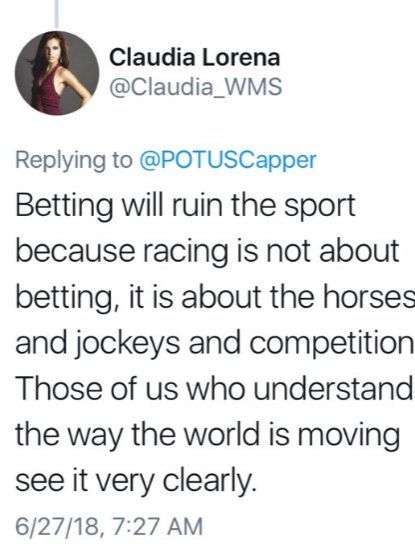
All of this serves as a preface to the since-deleted tweet that sent the handicapping section of horse racing Twitter into a frenzy Wednesday morning.

DgtN3HsXkAEbHld

I’m going to try to frame this as delicately as possible, for any number of reasons. On a fundamental level, the content of this tweet is as wrong as wrong can be, and pretty much everyone who responded to it said as much. This is as good a time as any to cue the Richard Dreyfuss line from “Let It Ride.”

DgtlkD1V4AAiPJu

Thanks, Danny!

Racetracks are based on two main sources of income: Owners who buy and race their horses, and gamblers who bet on them. All of this funds the tracks, which put up purse money. Without either part of that one-two punch, tracks are doomed to fail. Saying betting will ruin the sport goes against lots of established logic, because the truth is that large-scale racing could not survive without it.

If people aren’t betting, racing cannot thrive. The question isn’t just, “How do we get racing fans to the track, or to an ADW?” The second question, which is just as important, is, “How do we provide a foundation for new fans to bet with some degree of confidence once they decide to invest their money?”

One of my longtime friends dating back to my two summers in the Saratoga press box is Tom Amello, a longtime handicapper who prides himself on fan education. He did a seminar at the racing Hall of Fame prior to the 2013 meet, and he did a great job of keeping things simple and relatable. His concepts centered around the odds board and four basic types of fields that can assemble in a given race, and it came across as something simple enough for new fans to understand.

Tom knows what he’s talking about, and he’s got a lot of valid points. The problem isn’t that people are betting too much and losing sight of the other stuff. The problem is, in many ways, the exact opposite. It can be intimidating for new fans to come to the races and not have a clue what they’re looking at or how to make money.

One of the things I try to do with my DRF Formulator Angle segments, which more often than not go against likely favorites, is explain why I’m going against the grain. While much of my analysis is grounded in the numbers Formulator provides, a fair part of it deals with various parts of the form that can be spelled out. Every horseplayer has angles they’re partial to. If what I do helps one person find an angle that works for them and the way they’re comfortable wagering, that’s a win. If that person uses that angle to cash a ticket, that’s an even bigger victory.

Racing does a good job of spreading the glamorous reasons to go to the track. Having said that, what are we doing once they get there so that they keep coming back, and not just for Instagram photos? Sorry, folks: Photos in fancy outfits don’t keep the sport going. Cold, hard cash at the betting windows? That’s a different story.

(Important note: If I turn up missing in the next few days, chances are that paragraph is why!)

I attempt to bridge the information gap every day when handling DRF’s social media platforms. My goal is to make the people who see our content more aware of what’s going on so that they can consume it in the most productive way possible. Hopefully, what I’m doing is bringing content to the attention of fans who will be enriched by it. The rule of thumb I’ve always abided by is that smarter fans are better fans. If smarter fans are compelled to do more to be invested in our game (whether that’s gambling on the races or raising awareness of them), then I’ve done my job effectively.

Speaking from that experience, I think there’s more we could be doing to be more welcoming to newer fans with money to burn, and if you’re taking the time to read this, you’re part of the solution. Making new fans that are inclined to gamble is of paramount importance, and that’s something we need to do given the likelihood of legalized sports betting in the near future.

If racing does not put up a fight, the sport stands to lose significant revenue to its organized sports betting cousins that don’t have this problem. Why would a group of people bet on something they don’t understand when they’ve been watching sports their entire lives and can form justifiable opinions on them without much effort?

Contrary to a tweet that went viral Wednesday morning, we DO need gambling money, possibly now more than ever. Sharing the game and knowledge within it with someone who could benefit from it is the single most productive thing one can do.

If you’ve got insight, share it. If you’ve got advice and new players can stand to benefit from it, help them out. You were there once, and someone helped you understand what was going on. It’s your duty to return the favor, so that there’s a game for us to enjoy in the years to come.

CHAMPAGNE’S CAMPAIGNS: The Ballad of Big Brown

Even though I was there, I don’t remember much about the 2008 Belmont Stakes. My main memory of that day is picking out a spot on the third level of the Belmont Park grandstand an hour before the race. The crowd began packing everyone in like sardines, and in an effort to hold my position across from the sixteenth pole, I clutched a sign advertising the section below it for dear life. It wasn’t pretty, but after a few minutes of pushing, people got the idea that I wasn’t moving.

It’s taken me 10 years, but I’ve realized that’s a heck of a metaphor for the way racing fans hold on to certain beliefs. We hold on tight, with white-knuckled grips that signify either deeply held convictions or immense fears of being wrong, but either way, when such a topic arises in conversation, we’ll speak our respective pieces as loudly as we can.

I was a college student then. I’d just finished my sophomore year at Ithaca College, and much as I had for Funny Cide and Smarty Jones, I had successfully persuaded a parent (in this case, my father) to take me to the Belmont.

I watched with baited breath as Big Brown, the easiest of winners in both the Kentucky Derby and Preakness, strolled into the starting gate. The crowd’s buzz was audible, as it had been during my prior ventures to cancelled coronations in both 2003 and 2004.

The horses settled in the starting gate, among them the undefeated Big Brown, with Hall of Fame jockey Kent Desormeaux in the irons.

The race started.

And then, an instant later, it was over.

– – – – –

I got the inspiration to write this column from a brief discussion with Desormeaux on Twitter Wednesday morning. I’d just woken up, 45 minutes before the start of my work day, and I saw that he’d retweeted something saying he was online and answering questions.

Having heard several theories on what happened that muggy Long Island afternoon, and having not yet acquired the filter that comes with consciousness, I asked if any of the conspiracy theories about that afternoon held water. Desormeaux, predictably, was not amused.

There was, however, an ulterior motive to my line of questioning. If you ask a group of racing fans who the top horse of the mid to late-2000’s was, you’ll get a fair variety of responses. Many fans will say either Zenyatta or Rachel Alexandra. Some will say fellow Hall of Famer Curlin, or even Rags to Riches (the filly who edged the two-time Horse of the Year in the 2007 Belmont). Barbaro will also be fondly remembered, if only for the memories of what might have been if not for his catastrophic injury in the Preakness. Big Brown’s name likely doesn’t come up in that conversation. For various reasons, the bay son of Boundary isn’t seen as one of the best of his generation, despite wins in every single race he finished.

Much of this is undoubtedly due to the horse’s connections, which seemed to be under an interminable cloud of controversy. Big Brown was owned by IEAH Stables, which operated as horse racing’s version of a hedge fund. They had achieved considerable success with horses like 2007 turf champion Kip Deville and eventual 2008 champion sprinter Benny the Bull, but something about the enterprise did not mesh well with the racing establishment.

As the excellent Deadspin article on IEAH cited, perhaps it was the “new money” aspect of the organization that rubbed some the wrong way. What did not help the public perception of the enterprise, though, was IEAH’s trainer of choice. Rick Dutrow was one of the most gifted horsemen on the NYRA circuit, one that many feel was railroaded when he was slapped with a 10-year suspension. He was also brash, opinionated, and never afraid of a microphone, especially when the topic of conversation was one of his fastest trainees. As gifted a conditioner as he was, Dutrow did himself no favors when it came to public relations.

Horses cannot choose their connections. Many of the four-legged immortals whose form we admire were so talented that their owners and trainers were, in some way, bystanders to their brilliance, just like the rest of us. Man o’ War was that way. So was Secretariat. A case could be made for Zenyatta as well, given her personality and tendency to prance around walking rings as if she owned them (with one exception, she may as well have).

Even if he had cruised to victory in the Belmont Stakes, Big Brown would have never had that luxury. His owners were not the “happy to be there” types, nor was his trainer. A sect of the racing industry would have viewed Big Brown as the black sheep of the Triple Crown winners, horse racing’s equivalent to the cousin or uncle that never gets invited over for Thanksgiving dinner. In no way is this the fault of a supremely talented racehorse that was on the verge of greatness, but such is the legacy of Team Big Brown.

For these reasons, Big Brown has been given the short end of the stick for a decade. In no way is this more evident than when you compare the 2008 standout to a horse of more recent vintage that hit a similar wall (or, more accurately, was hit by a similar hoof) when going a mile and a half in New York.

– – – – –

The year was 2014. A California-bred of humble beginnings had taken the horse racing world by storm, and was now one Big Sandy lap away from doing what Funny Cide, Smarty Jones, and Big Brown could not.

California Chrome walked into the starting gate beneath Victor Espinoza, whose career the son of Lucky Pulpit almost singlehandedly revived. Once again, I was there. This time, I was on assignment for HRTV, and I was watching not from the grandstand, but from the Long Island Railroad platform near the top of the stretch, less than 100 yards from the HRTV trailer.

Chrome broke a bit awkwardly, but settled into what seemed like a fine trip. Turning for home, he looked like a winner, and Espinoza began pumping his arms. However, when the eventual Hall of Fame reinsman stepped on the gas pedal, he found that the tank was empty. California Chrome hung and settled for fourth behind Tonalist.

Within 24 hours, former HRTV and TVG colleague Scott Hazelton had unearthed a reason for Chrome’s flat performance. Matterhorn, a hopeless longshot in the race, had stepped on the Triple Crown hopeful out of the gate, causing a massive gash that took social media by storm. In the eyes of the racing world, California Chrome’s effort went from disappointing to borderline heroic, and followers eagerly waited to see when the fan favorite would return to the track.

He raced three more times that year. He was once again one-paced in the Pennsylvania Derby, which was unapologetically viewed by his connections as both a prep and a paid workout given the incentives offered by Parx. He then ran a strong third in the Breeders’ Cup Classic, a race marred by Bayern’s antics out of the starting gate and a non-disqualification that’s even more indefensible now than it was at the time, before cruising home in the Grade 1 Hollywood Derby on turf at Del Mar. Despite losing to Bayern twice, and despite failing to win a Grade 1 on dirt after the Preakness, California Chrome was voted the 2014 Horse of the Year.

All of this goes in stark contrast to what took place six years earlier. Big Brown was stepped on coming out of the gate by a horse named Guadalcanal, a horse for whom Joe Nevills’s “no times 17” haiku would’ve been appropriate. As Desormeaux said, ESPN followed the trail of blood all the way back to the barn. Big Brown bounced back to win twice more before being retired prior to a highly-anticipated Breeders’ Cup Classic showdown with Curlin…and yet could finish no better than third in Horse of the Year voting. Curlin had done enough to earn the trophy despite a fourth-place finish in the Classic, but the real shock was that Zenyatta, who hadn’t yet run against males, finished second. The four Grade 1 wins, two of which came in Triple Crown races, as well as a win over older horses on turf in a $500,000 race…earned Big Brown 13 first-place votes.

Why does history make Big Brown pay for the sins of his connections? Separate the horse from the humans around him, and you have one of the most brilliant horses since the turn of the millennium, one that may have been even better on turf than he was on dirt. Racing’s lineage is filled with imperfect characters of the human variety, whether any of us want to admit it or not. The way we perceive Big Brown, 10 years after his failed Triple Crown bid, reflects the ever-selective “character clause” that’s so popular in other sports. I’m of the belief that one can separate the horse from the people associated with it, and that this is the way we should approach the 2008 dual classic winner.