A long time ago, I composed a 50-point plan to improve horse racing’s future prospects. One of the most important ones was also probably the simplest one on the list. It was two words, and comprised a philosophy that racing had yet to embrace at that time.
“Optics matter.”
You know why I’m writing this column. It was announced Sunday morning that Medina Spirit, the winner of the 2021 Kentucky Derby, tested positive for a banned substance. We’re now playing the waiting game as a split sample gets tested. If that comes back positive as well, we’ll see just the second medication-based disqualification in Derby history.
When trainer Bob Baffert was reached for comment on the situation, he denied giving Medina Spirit the illegal substance.
“I don’t know what is going on in racing right now but there is something not right,” he said to reporters Sunday. “I don’t feel embarrassed, I feel like I was wronged.”
This is consistent with his responses to situations involving top-tier horses such as Justify, Gamine, and Charlatan, among others, all of whom tested positive and have largely had those situations swept under the rug. In the latter two cases, the Arkansas Racing Commission recently overturned rulings made by its own stewards and reinstated victories for those two horses. Justify, meanwhile, tested positive for scopolamine following the 2018 Santa Anita Derby, but was not disqualified, either immediately after the test results came in or after lengthy legal proceedings stemming from a lawsuit filed by Bolt d’Oro’s owner/trainer, Mick Ruis.
I’m not a vet. If you’re looking for a detailed analysis of the substance Medina Spirit tested positive for, you’re going to need to look elsewhere. What I am is a lifelong racing fan, a handicapper since I was in middle school (for better or for worse), and someone with a career in marketing and communications that can provide some insight into how this will go over with the people racing needs in order to survive.
Spoiler alert: It’s not going over well.
Many in racing want the sport to be mainstream, as it was many years ago. As Alicia Hughes, a friend of mine and one of the best writers in the game, continually points out, this means an acceptance of criticism and coverage that is good, bad, and indifferent. Right now, what we have are a bunch of people who are very angry, for legitimate reasons.
Those who bet Mandaloun, who ran his eyeballs out to be second and tested clean, feel robbed. Those who took to social media to complain after the Derby, either because they didn’t use a 12-1 Bob Baffert trainee in a race he’d won six times before last weekend or because they genuinely felt something was afoot, have all the ammo they need to say the game is crooked (though cries of “I’M NEVER BETTING AGAIN” from those who shove the GDP of a developing nation through the windows or ADW’s will always come across as hollow and/or ego-driven).
How does any of this help racing draw the new fans it desperately needs? How has racing’s continued inability to effectively police itself in any way, shape, or form helped ensure a place for itself moving forward? And when will people who have the ability to make decisions that impact the sport moving forward realize trainers constantly complaining about being wronged are taking lessons from the Taylor Swift School of Spin, where nothing bad is ever their fault?
The answers: It doesn’t, it doesn’t, and they won’t, at least not without significant prompting to do so.
It took the FBI moving in for Jorge Navarro and Jason Servis to be run off the racetrack. In Navarro’s case, he had a rap sheet as long as Giannis Antetokounmpo’s arm but continually received mere slaps on the wrist as he took bottom-level claimers and turned them into stakes winners. All the while, bettors had an idea of what was going on, bet money accordingly, and watched as racing took no significant action despite enough smoke to indicate a giant wildfire.
At a time when perception is everything, it seems racing is deliberately choosing not to be proactive. In combating the issue of race-day medication, the sport decided to phase out Lasix, a substance designed to stop horses from bleeding. While Lasix may be A problem, the Medina Spirit situation shows it was not THE problem. Add in that horses may need Lasix to run at the sport’s highest level due to the way horses are bred in 2021, and that several of those top-tier equine athletes have bled during races, and anyone who’s watching closely knows significantly more work is needed in order to ensure any consistency and integrity moving forward.
If Medina Spirit’s split sample comes back negative, I hope it’s a stimulus for the complete and total rebuild of post-race testing from coast to coast. I don’t care what it costs, nor what the hurdles are in instituting a nationwide system where all results can be trusted. If we can’t get this right when the entire world is watching, who’s to say we’re getting this right when it isn’t?
If Medina Spirit’s split sample comes back positive, I hope it’s a stimulus for a new era of stricter sanctions for trainers who cheat. Horses run for millions of dollars, and paltry fines that amount to change “supertrainers” might find between their couch cushions means the usual punishment doesn’t come close to fitting the crime. Meaningful fines and suspensions, ones that shut the door for assistants to step in as program trainers and allow a “business as usual” mentality, are long past due.
Optics matter. And if for horse racing doesn’t apply those two words to this situation on a national level, it casts doubt on if the sport ever will in a meaningful way.
The following conversation took place on Normal Andrew’s couch on a recent day off from work. Those unfamiliar with the Gimmick Andrew concept should read this piece published in 2018, at which point many perceived notions about Normal Andrew’s behavior should evaporate.
To make things easier to read, Gimmick Andrew’s quotes will be in italics.
– – – – –
“…who let you in here?”
“You did. This is YOUR subconscious, dude.”
“Fair enough.”
“What’s new?”
“Rushing Fall cost me a Pick Six and I’m sweating The Pink Sheet’s pick box like it’s a life-or-death situation.”
“So not much.”
“Yeah, that’s all pretty on-brand.”
“Why am I here, then?”
“What do you mean?”
“I only come out when there’s a defined reason for my existence. Clearly, something’s got you acting pensive and thinking weird thoughts. What is it, Saratoga running without fans?”
“No, that was actually the right move.”
“No fans at the Derby?”
“Unquestionably the right move, and one that should have been made months ago.”
“Your new podcast, ‘Champagne and J.D.?’”
“The one everyone should open in a new tab to check out? No, that’s going pretty well. We’ve gotten a great assortment of guests on a wide range of topics, and J.D. Fox and I are really proud of what we’ve built.”
“I’ll go build a fake Gmail account and subscribe.”
“Good. Tell your friends to do the same.”
“Why’d you even start that, anyway?”
“A couple of reasons. We wanted to give people something to have fun with during the pandemic, and neither of us were particularly happy with…oh.”
“What?”
“I just figured out why you’re here.”
“Keep going, then. I’d prefer if you didn’t waste my time with commercials nobody asked for that wind up making horse racing content impossible to watch, read, or listen to.”
(An uncomfortably long pause ensues as both Andrews glance deeply into an imaginary camera.)
“Well, I’ve got genuine issues with the way the sport is being marketed.”
“How’s that any different from what you’ve believed for years?”
“I don’t work in horse racing full-time anymore. I haven’t for two years.”
“Do you miss it?”
“Working in horse racing?”
“Yes.”
“Every single day. And that’s not to say I don’t like what I do now. But there are days where I firmly believe I was put on this planet to make a positive difference in the sport I love.”
“You have.”
“I’d like to think so.”
“Well, again, this is YOUR subconscious.”
“I miss the racetrack. I miss being able to promote the sport in a meaningful way, with people recognizing I know what I’m doing and letting me do it.”
“Is anyone else out there doing the stuff you want to do?”
“Nowhere near enough. I was born about 50 years too late. There aren’t full-time turf writers left, and a lot of good, solid racing people have been shown the door.”
“Then why put so much time and energy into something that doesn’t seem to want you around?”
“Because I care. Because there are issues I can fix.”
“Like what?”
“Who out there is creating content produced by horseplayers, for horseplayers? Some people. Not many. Racing is bound and determined to market to an attractive potential audience rather than the one it actually draws. What I do isn’t sexy. But what I do works, and there’s data that shows it.”
“What do you do, exactly?”
“I write, I produce videos, and I do so in a way that appeals to the biggest audience possible, the one horse racing wouldn’t survive without. Everywhere I’ve gone, social and digital media numbers have shot through the roof. And when people in charge of this stuff around the industry now do so in a way that’s sloppy, or insulting, or shows a defined lack of research…I get angry.”
“As angry as you got three and a half years ago?”
“Not quite. Close, though.”
“So what’s your plan?”
“Well…”
“Say it. If people are going to think you’re loud, or pompous, or have an ego, give them a reason.”
“You’re a horrible influence.”
“Say it.”
“…if nobody else is doing it, maybe I should.”
“That’s the spirit.”
“If not enough people are creating meaningful content for racing’s biggest audience, and if I’ve shown that’s something I can do effectively, maybe it falls on me to do that.”
“My work here is done.”
“Wait. How do I start?”
“What do I look like, your assistant? Finish Saratoga, then figure that out. If you need me, start having internal dialogues. If I’m not busy abusing your Netflix account, maybe I’ll come back.”
“Is that why I’m getting weird documentaries as recommendations?”
“Watch ‘Tread.’ Dude makes a bulldozer and tries to steamroll an entire town.”
“You’re strange.”
“I’m you.”
“Well, I’m the guy bound and determined to do something positive for horse racing.”
I sauntered off the sixth green at Pebble Beach Golf Links on a beautiful summer day several steps ahead of the rest of my group. This twist on social distancing was by design, because I needed a minute.
I stood on the seventh tee box after filling our caddy in on what I was feeling and why I needed some time. Looking down on the green from about 100 yards away, preparing to play one of the most picturesque par-3 holes in golf, my eyes started welling up.
I waited as my dad, he of numerous club championships in upstate New York and a 4.8 handicap index to match, hit a wedge about 30 feet past the hole.
“I’d buy that right now if I could,” I thought to myself as I put my yellow Callaway, colored to make life easier for my caddy when shots inevitably went askew, down behind the tee markers.
I took a deep breath as I addressed the ball, hunched over due to the whole “I’m 6’5” and golf isn’t a sport for giant people” thing. I bent my knees, brought a three-quarter swing back, and came through the ball.
We’ll leave that shot in the air for a little while. In this case, the journey to Pebble Beach and the emotions it brought out, rather than scores written on a card, is what mattered more than anything else.
– – – – –
My dad was supposed to go to Scotland in May on a journey that would include 18 holes at St. Andrew’s. He was pumped to cross several things off of his bucket list…and then the coronavirus screwed everything up.
After planning a journey to Northern California, Dad did some digging. The research led to a shocking discovery: Pebble Beach was not requiring its traditional two-night hotel stay in order for guests to play one of the most famous courses in all of golf.
Following a few phone calls, Dad and I had a 10 am tee time for his trip out here. I was excited, but also scared out of my mind. As I’ve written, I enjoy playing golf, but I’ve never been anywhere near good at it. Occasionally, I’ll slap a few good holes together, but between my busy schedule and the whole “I’m way up here and the ball’s way down there” thing, it’s just never been something I’ve been able to improve at.
Before his arrival in the Bay Area, I took my clubs out for a spin and tried to work out the kinks. I was encouraged by my first outing, when I shot 44 on a par-34 course near my apartment, but visits to several 18-hole layouts varied from “humbling” to “where is my face and why did this force-carry decide to rip it off?”
When Dad got here, we played Hiddenbrooke, a public course in Vallejo (about an hour north of Oakland). It’s a beautiful Arnold Palmer design that has hosted several LPGA Tour events, and my banana-like tee shot was in no way prepared for it. After recording an 18-hole score of 108 (and a liberal 108 at that), plans were made to hit the driving range on Sunday.
Due to either uncommon foresight or common hoarding (both frequent behaviors within the Champagne family), we had several drivers laying around. One of them, a Taylor-Made, had an adjustable clubhead, and one of the employees at the range had a screwdriver. After moving the setting very far to “draw,” with a clubhead that may as well have been at a right angle, I at least had some general idea where the ball was going.
That enthusiasm waned when Dad decided we needed to be awake at 5:30 am for the drive to Monterey the next morning. How am I supposed to apply what I learned and swing a golf club correctly, I thought, if my consciousness was still laying on my couch? Alas, that was a battle I was never going to win. The alarm, predictably, came early, and off we went to Pebble Beach.
– – – – –
We left my apartment at 6:23 (I know because Dad complained we were eight minutes late). The first win of the day came when Bay Area highways, known for being some of the worst in the country, were miraculously mostly empty save for a trouble spot near San Jose caused by debris in the road. We got from parking spot to parking spot in almost exactly two hours, which allowed for plenty of wandering around before our tee time.
As Dad went into the shops, I found myself looking at the wall of plaques honoring winners of professional and amateur events held on the course. I couldn’t help but wonder, “what the heck am I DOING here?,” as I read about the exploits of Tiger Woods, Phil Mickelson, Gary Woodland, and a host of other golf legends.
— Andrew Champagne (@AndrewChampagne) July 6, 2020
Before going to the putting green, Dad and I watched a foursome tee off. The last player was a kid, maybe 10 or 12 years old, and Dad remarked how the kid may not be old enough to appreciate Pebble Beach. I countered by saying, “you watch, the kid probably has a better swing than I do.” I was proven correct when he hit a decent little drive about 180 yards down the right side of the fairway, one I’d have gladly bought from him had he been willing to sell.
I deliberately kept my goals low. In summary, there were only a few benchmarks I wanted to hit.
– Don’t be the worst player our caddy had ever worked with (mission accomplished).
– Take two shots to get out of as few bunkers as possible (this happened twice, but it could’ve been worse).
– Don’t leave the ball on the hill separating the fairways on the sixth hole (I hit one of my best shots of the day to get a hybrid over the hill and near the green).
– Par the seventh hole (we’ll get to that).
We met our caddy, Mike Z., and our playing partners on the first tee. I warned him, “you won’t need to help my dad much, but I STINK.” He laughed, and he would wind up doing an amazing job for us. Pro tip: If you play Pebble Beach, spend the money for a caddy. They’ll help you around, provide a wealth of knowledge (especially around the greens), and can even act as photojournalists taking photos and videos throughout your round. I can’t possibly recommend Mike Z. any higher, either. He added to the experience in a way we’ll always rave about.
Dad striped his tee shot down the first fairway, and then it was my turn. Somehow, I put together a controlled series of motions resembling an OK golf swing. While the yellow Callaway had left-to-right spin on it and found the right rough, it gave me a clear second shot into the green and was far from the worst tee shot the starter would see that day.
In an odd, welcome plot twist, I actually scored pretty well early. I bogeyed the first three holes, but made several 15-foot putts to do so, including one on the third hole that took one or two trips around the cup before falling in.
I made the turn in 53, with only three lost balls (coming on the fourth, eighth, and ninth holes). Despite wasting a great opportunity by dumping a wedge into the hazard after my best drive of the day on the ninth hole (a low stinger that caught a downslope and kept rolling), I considered the front nine a complete and total success. This continued when I made par on the 11th hole (albeit on a first-tee mulligan when I grounded one just barely off the tee box; I then hit a decent drive up the fairway, a good 7-iron to within about 25 feet, and two-putted). At that point, visions of a 99 danced in my head.
And then the back nine at Pebble Beach ate my lunch.
The 14th hole is when the day took a turn for the worse. After a drive into the right rough off the tee, I hit two solid hybrids to within about 60 yards of the hole. Unfortunately, that left me with one of the most daunting shots on the golf course: An uphill half-wedge, with no green to work with and a bunker staring at me with a menacing, “COME AT ME BRO” look.
Fun question!
For my money, this is the most terrifying approach shot in golf on #14 at Pebble Beach. What do you think I did with it? pic.twitter.com/97Pet4jXRC
— Andrew Champagne (@AndrewChampagne) July 6, 2020
I attempted to hit a half-wedge, but was intimidated enough to hit a three-quarter wedge that went long-left and flew the green. Several chunks and bad putts later, I slinkered off to the 15th tee box, where I hit one of my few push-slices of the day. Somehow, it stayed in bounds, and I wound up with a punch shot that I’d hoped to send between two trees and out to the front part of the green. I made great contact and missed one with ease, but the ball clipped an extending branch of the second one and went straight down into the ground.
“Five feet left and it’s perfect,” I grumbled on my way to making 7.
Still, I had a chance at a decent score (by my subterranean standards) as we headed to the 17th hole. I wound up playing most of the long par 3, as I grounded the tee shot short, put a second shot into the bunker short of the green, took two to get out, hit out of the bunker LONG of the green, and made a less-than-graceful quadruple bogey.
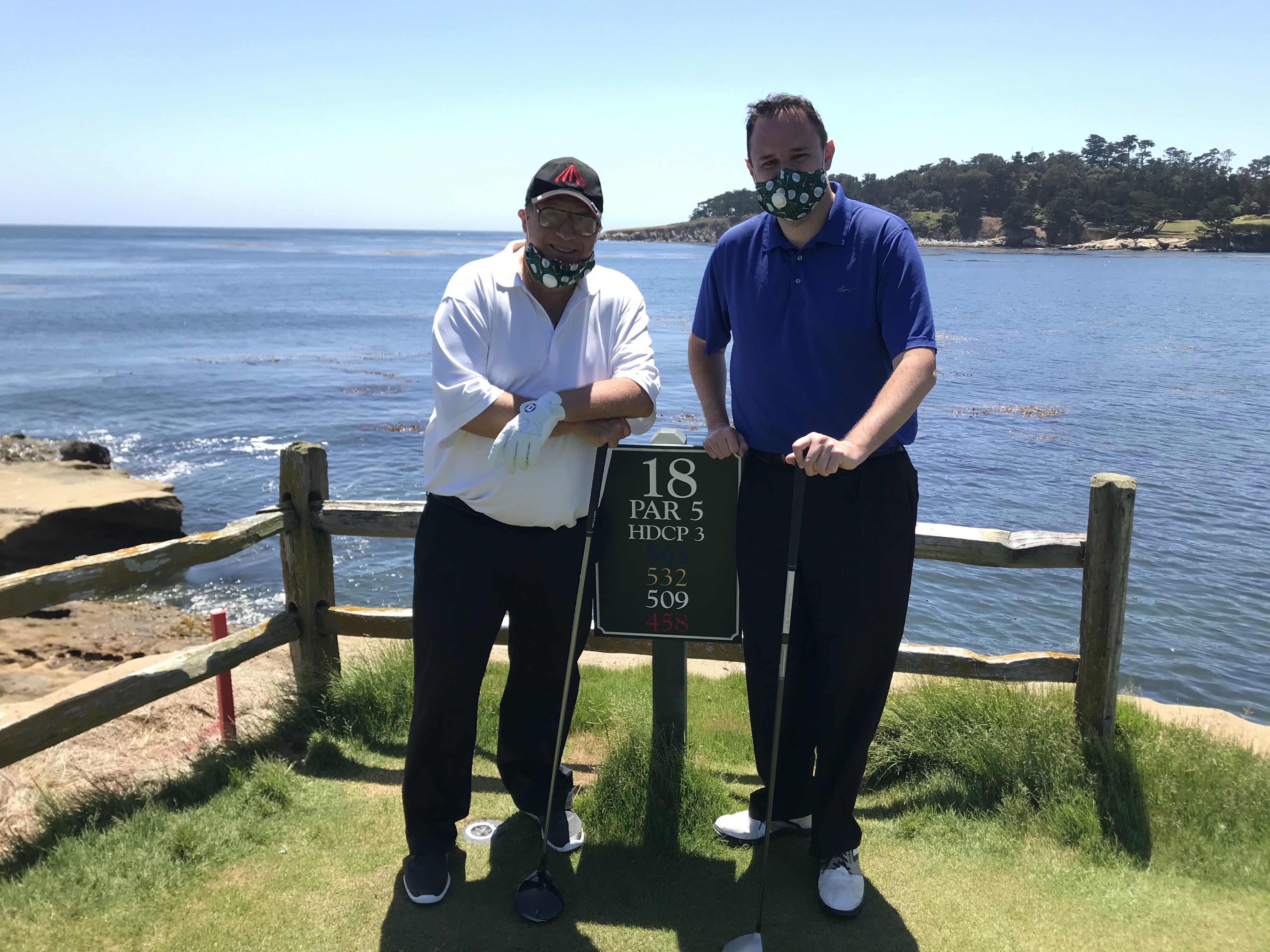
After taking a few pictures on the 18th tee box, though, I exorcised the demons with a beautiful drive up the right side of the 18th fairway. I hit a decent second shot, too, but chunked my third and wound up directly behind a tree adjacent to the green. Once again, I made 7, and I wound up signing for a 111 while Dad found ways to grumble about turning a 77 into an 84 (I hate him sometimes).
I did, however, say that scores didn’t matter as much as other things. This is where we teleport back to the seventh hole.
– – – – –
As you may know, my grandmother, Carolyn Hake, passed away earlier this year after contracting the coronavirus. Between being 3,000 miles away and the pandemic not allowing for funerals or memorial gatherings of any kind, I never really got a chance to say goodbye to her, and it’s eaten at me for a while.
Many years ago, she got to play Pebble Beach with my grandfather (my mom’s dad), who at his peak was a scratch golfer. The story I was told went like this: They got put with two guys who wanted no part of playing with a woman. Nana countered as only she could, kicking their butts all the way around the golf course. The highlight came on the seventh hole, when she hit a wedge in and made par.
This is why keeping myself composed on the seventh tee box was hard. It’s why I wouldn’t have been surprised if the ball went anywhere between 10 feet off the tee box or halfway to Oahu, and why I needed to be careful in ensuring the golf club wasn’t shaking in my hands as I took it back.
I can only speculate, but chances are the wedge she hit was probably far more graceful than mine. While I hit it somewhat fat, though, the ball came off the center of the clubface and went to the right of the flagstick, where I had aimed in hopes of accommodating an ocean breeze that naturally subsided when I made contact.
“GO!,” I yelled, hoping it wouldn’t land in a bunker shy of the green.
The yellow Callaway obliged. It hit the green and rolled just off the back fringe, and golfers all over the course probably heard me yell, “FINE!,” from under the golf-themed mask my girlfriend bought me.
We got down to the green, and I was the first to putt from my lie in the rough. I had the speed perfect, but the ball stopped a foot or two to the right of the cup. Dad gave me the par putt and I took the ball away, pumping my fist as discreetly as I could while my eyes welled up again.
Dad lined up his birdie putt right as I’d recomposed myself. Like lots of putts at Pebble, it wasn’t easy. It went left to right, with a few feet of break and ocean waves crashing in the background.
He hit the putt.
There was no discretion necessary in the reaction.
There were a lot of special moments in that round. I’ll remember putting before the round and the practice green magically emptying for us for 10 or 15 minutes. I’ll remember the pictures we took and how lucky I felt to be with my father in those moments. I’ll remember remarking to my caddy, “these putts DO break the same as in the WGT video game!” I’ll remember going up to people working in various spots, from marshals to food and drink venders to salespeople in the shops, and saying, “you must REALLY love your job.” I’ll remember all of them saying that, yes, they did indeed love their jobs.
The seventh hole, though? That’s burned in my brain, and it’ll stay there as long as I live.
I never got the chance to say goodbye to my grandmother. I suppressed the feelings from that for quite a while, simply because there’s no playbook to dealing with that stuff and there was no acceptable way to deal with the grief and frustration that I felt. Doing something she did as well as she did it isn’t going to heal everything, but it’s as good as I was going to do. Sometimes, that has to be enough.
I debated throwing my ball into the ocean after the hole was over, but I decided against it. After all, the ocean would have many more chances to deliver a souvenir to her, and that’s what it did on the next hole. After hitting a really nice 4-iron to just shy of the cliff’s edge, I took a 5-wood, attempted what Jack Nicklaus calls the greatest second shot in all of golf…and pushed that yellow Callaway dead right into the Pacific Ocean.
“Close enough,” I though to myself as I put another ball down.
The score really didn’t matter. Everything else did.
My dad’s coming to the Bay Area in a few short weeks. Thanks to the coronavirus pandemic, many of our usual father-son activities are off the table. For instance, in-restaurant dining is out of the question (even if it was allowed, we almost certainly wouldn’t do it, for understandable reasons), and while horse races will be run at the Alameda County Fair in nearby Pleasanton, fans will not be allowed on the grounds.
One thing we can do, however, is play golf. My dad is a lifelong player, a multiple-time club champion at various courses in upstate New York, and a single-digit handicap who often finds ways to grumble about scores in the high-70’s. I know this because he usually calls me on his way home after posting said scores.
In my case, though, “play golf” is a relative term. Perhaps the more appropriate description of my activity would be “attempt to not awaken the ghost of Old Tom Morris by partaking in the biggest earth-moving project in the history of Contra Costa County.” My all-time best round was a 96 at Rancho Park in Los Angeles, the former site of the LA Open before it moved to Riviera. I finished par-par-par, including a 5 on a finishing hole that once induced a 12 from Arnold Palmer, and I felt like turning my driver into a bull, a la Adam Sandler in “Happy Gilmore.”
I’ve never been a consistently active golfer, even after moving to California, where the golf season doubles in length from where I grew up. I enjoy the game, but between working on weekends for most of my career and having a lot of other stuff going on, I’ve never had the time to devote to being good at it. Add in that they don’t really make golf clubs for people who stand 6’5” and that most golfing activities involve bending something that usually doesn’t bend much for people my height, and you wind up with an awkward marriage of hobbyist and hobby.
This may seem verbose, but you need to have a clear picture of all of it, as everything you’ve just read leads to a two-part declaration.
Part one: My father and I will be playing Pebble Beach.
Part two: I am mortified.
This is the most renowned public golf course in the country. It’s hosted six U.S. Opens. Nicklaus hit one of the best shots of his career with a 1-iron here. Watson holed the ultimate “you could put a bucket of balls out there and never do that again” chip here. Tiger could’ve won the 2000 U.S. Open here playing on his knees.
And they’re letting ME play there?
I sweat over the pick box in Saratoga’s Pink Sheet every day of every meet. I hurl my phone into the couch when horses I bet lose photo finishes (my phone and couch can attest this happens often). I rage-quit video games, and I full-heartedly fling myself into things where nothing more than bragging rights are on the line (if you’re in Group Four in the contest being put on by the fine folks at The Daily Gallop, you know this already). Put that together with a tee shot that naturally veers further to the right than Mitch McConnell, and you have a recipe for disaster.
I need help, and lots of it, so I’m trying to work my way into something resembling decent form ahead of my father’s visit. Step one came Sunday with a trip to Diablo Hills, a nine-hole, par-34 course a few miles from my apartment. I got thrown into a foursome with three nice, outgoing people who were kind enough to laugh at my usual pre-round proclamation, “I suck, but I suck quickly.”
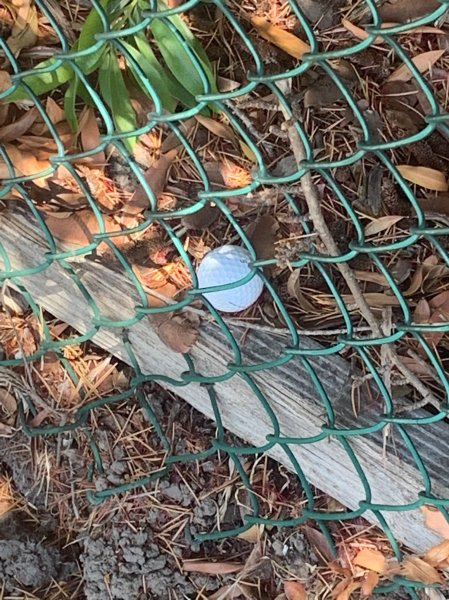
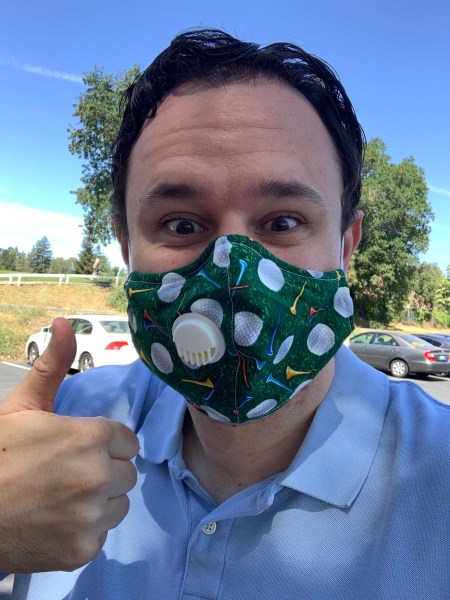
Early returns were not promising. After teeing up the first of three Titleist golf balls marked, “I’M NOT LOST, I’M HIDING FROM ANDREW CHAMPAGNE,” I took a deep breath through my mask, pulled, my driver back, and gave it a big move through the ball. True to form, the drive looked great for about 75 yards before making a hard right turn and ignoring my pained cries of, “hold, ball!” When the ball stopped 200 yards from the tee, it did so thanks to a conveniently-placed fence that trapped it in its wiring.
After thanking the fence profusely for its service and giving myself a drop that was questionable in legality (basically, I treated the fence as though it was a hazard and used the foolproof, “I’m not walking all the way back there to hit another tee shot,” defense), I pulled out a wedge, and all of a sudden, things got weird, as my body was momentarily possessed by a golfing spirit that knew what it was doing. My uphill shot dodged a nearby tree, floated through the air, and came to rest on the front part of the green about 40 feet from the cup. I salvaged a two-putt bogey, and with that, we were off and running.
Diablo Hills is built around several apartment complexes, several of which must feel like war zones in the summer with golf balls bombarding roofs, walls, windows, and parked cars from dawn to dusk. The fourth hole is a 90-yard par 3 down a hill near a major road in town. My playing partners confirmed moving cars had been hit by errant tee shots in the past, so I had plenty of apprehension as I stood over my ball (especially since said ball had my full name on it and could be used against me in traffic court).
I gave it my best three-quarter wedge swing, and it looked good off the clubhead.
“Be right,” I pleaded as it approached the green and a bunker guarding it.
It was, but barely. It missed the side of the bunker by about three feet, bounced once, and skidded to a stop about 10 feet past the hole.
Fear not, though, as I remembered my lack of skill on the green and squirted the birdie putt a foot or two past the cup on the right side. Crap.
Still, I wound up playing like I actually had some sort of clue, which shocked me. Despite a three-putt double-bogey on the course’s lone par-5 (a devilish, 500-yard uphill hole that points and laughs at walkers too brave/cheap to rent a cart), I signed for a respectable 44, and it could’ve been two or three shots lower with better putting and/or drives kept on the planet.
I felt strangely optimistic as I took my golfer’s mask off in the car. Diablo Hills is no Pebble Beach, but if I can straighten out the big stick and start making some putts, perhaps I won’t totally embarrass myself on a big stage.
Then again, if I do, it’ll make for a pretty funny column.
Over the weekend, in a desperate search to keep my mind occupied following the death of my grandmother, I found myself going down a social media rabbit hole. When I got on Twitter and saw my timeline, I was taken aback by the sheer volume of audio/visual content produced by the people I follow.
There were podcasts, live streams, and quick video hits galore, all hitting a bunch of different tones for different subsets of the racing fanbase. In one way, I was pretty happy, because it meant I was following the right people. In another, I couldn’t help but remember some of the reactions I got when part of my job was doing this exact sort of thing.
From mid-2012 through late-2018, I was a driving force behind the social and digital media strategy at several racing networks and publications, including The Pink Sheet in Saratoga, HRTV, TVG, and The Daily Racing Form. At each stop, social media reach and engagement grew considerably (sometimes far more than that), due in large part to strategies that brought content horseplayers wanted to access to them in more convenient ways. I say this to establish that I know what I’m talking about thanks to years of experience appealing to people like myself.
When I did that stuff, though, there were times where the reactions were far from positive. When I did live chats in Saratoga and filmed daily editions of The Pink Sheet Insider, some print-oriented folks at The Saratogian made no secret that they thought I wasn’t using my time wisely. When I started filming video hits for social media as part of my job at TVG, at least one person took to calling my makeshift studio the “wacky-capsule,” as a take-off of the old “handi-capsule” that became the TVG2 studio.
Just a few years later, everyone’s doing the same exact thing, from “wacky-capsules” of their very own. Life comes at you fast, huh?
I’m not looking for a pat on the back or some admission that I saw things coming (though if you’d like to give me one, or in some cases admit you were wrong many years ago, I won’t object). I’m bringing this up because, during the COVID-19 crisis, parts of racing’s establishment have finally accepted that there are other ways to reach their most important audience. Not everything has to be put on a television, or micromanaged by someone sitting behind a big desk. Give your handicappers a phone or a video camera, make sure they have a place to sit with a cool background, and let them go nuts by showing their knowledge, handicapping skills, and passion for the sport.
I could tell a lot of stories about stuff I did and how we improvised on the fly. Jeff Siegel and Aaron Vercruysse gave me a shot on HRTV’s streams from Belmont and Santa Anita in the final months before that network was acquired by TVG, and I loved it. Most of all, I enjoyed seeing the analytics that showed we weren’t a competitor to pre-existing offerings, but a complementary piece of content for horseplayers who wanted a little extra. That the prevailing reaction among most of my colleagues who watched was, “I thought you were going to be goofy, but you can actually do this,” was merely a bonus.
When TVG hired me on, I kept that concept going under the “TVG Extra” name for as long as I was allowed to, but also took things a step further with some concepts many of you enjoyed. First, I somehow got the approval for the aforementioned “wacky-capsule,” which featured a one-camera setup, a switcher, a lighting rig, and a computer to edit on. I’d call Paul in the graphics department, he’d shoot over the fields his crew had produced, and after a few minutes of filming, I’d have everything I needed to create stuff like the video below (which was our most-watched YouTube video the week before the 2016 Breeders’ Cup).
I also started a weekly online show called the “Pre-Game Periscope” every Saturday morning. I grabbed my iPhone 6, set it up on a makeshift stand that consisted of phone books arranged thickest to thinnest, laid out my past performances, hit “go live,” and streamed for a half-hour to 45 minutes. The production values were non-existent, but you know what? Nobody cared. That little show got hundreds of live viewers each week, and pushed past 1,000 a few times on big days. No graphics? No music? No b-roll? No television distribution? No problem.
“TVG Extra” died the day of the 2016 Santa Anita Handicap. The Pre-Game Periscope, and the hits I did for TVG’s social media audience, died about a year later (the full stories on all of these will be available in my memoirs, which will come out when I’m in desperate need of Pick Four money). Now, just a few years later, those formats are back, and EVERYONE is doing them. Barstool Sports runs a handicapping stream wherein they’re airing race calls as they happen. I remember when my then-boss (one of the best people I’ve ever worked for) had to talk a major organization into not shutting down a “TVG Extra” stream because they hated we were using their video feed.
Times change, and as an industry, horse racing needs to change with them. It’s no secret that this isn’t something the sport has traditionally done well. I’m encouraged that so many organizations are finally letting their talented people loose with this stuff, but that’s only half the battle. What happens if and when COVID-19 subsides and people start going back to offices, race tracks, and TV studios?
Production of this content shouldn’t stop simply because some things are closer to being back to normal. I’ve seen a lot of content out there that’s creative, imaginative, and never would have gotten approved before the word “coronavirus” entered our collective vocabulary. We’ve changed our minds on a lot over the past few months. Let’s look at the landscape and allow ourselves to realize we need to evolve, okay?
As a content producer, a digital media expert, and someone who desperately wants to see horse racing and its current and aspiring on-air talents grow, I’m using this space to send a simple message to anyone who’s producing content or wants to produce content: Don’t stop. Take whatever’s inspiring you and run with it. If someone’s complaining, chances are they’ll be copying you in a few years. Use it as fuel, and as affirmation what you’re doing is almost certainly working more than the busybody-in-question wants to admit.
If you need some guidance, or advice, or someone to vent to, fill out the “contact” form. What you send goes to my email, and I see everything that comes in. You can also tweet me at @AndrewChampagne, where you can find all of the content I produce on a regular basis.

 I need help, and lots of it, so I’m trying to work my way into something resembling decent form ahead of my father’s visit. Step one came Sunday with a trip to Diablo Hills, a nine-hole, par-34 course a few miles from my apartment. I got thrown into a foursome with three nice, outgoing people who were kind enough to laugh at my usual pre-round proclamation, “I suck, but I suck quickly.”
 After thanking the fence profusely for its service and giving myself a drop that was questionable in legality (basically, I treated the fence as though it was a hazard and used the foolproof, “I’m not walking all the way back there to hit another tee shot,” defense), I pulled out a wedge, and all of a sudden, things got weird, as my body was momentarily possessed by a golfing spirit that knew what it was doing. My uphill shot dodged a nearby tree, floated through the air, and came to rest on the front part of the green about 40 feet from the cup. I salvaged a two-putt bogey, and with that, we were off and running.
 I felt strangely optimistic as I took my golfer’s mask off in the car. Diablo Hills is no Pebble Beach, but if I can straighten out the big stick and start making some putts, perhaps I won’t totally embarrass myself on a big stage.
 Andrew Champagne