Golden Gate Fields had its second dispersal auction not long ago. The Northern California track closed its doors in June and had an initial auction in the fall, but there were enough leftovers to justify a second go-round.
The first auction didn’t go well for me. I got outbid for everything but several sets of glasses celebrating renewals of the Kentucky Derby and Santa Anita Handicap. This time around, though, there was an item I simply had to have.
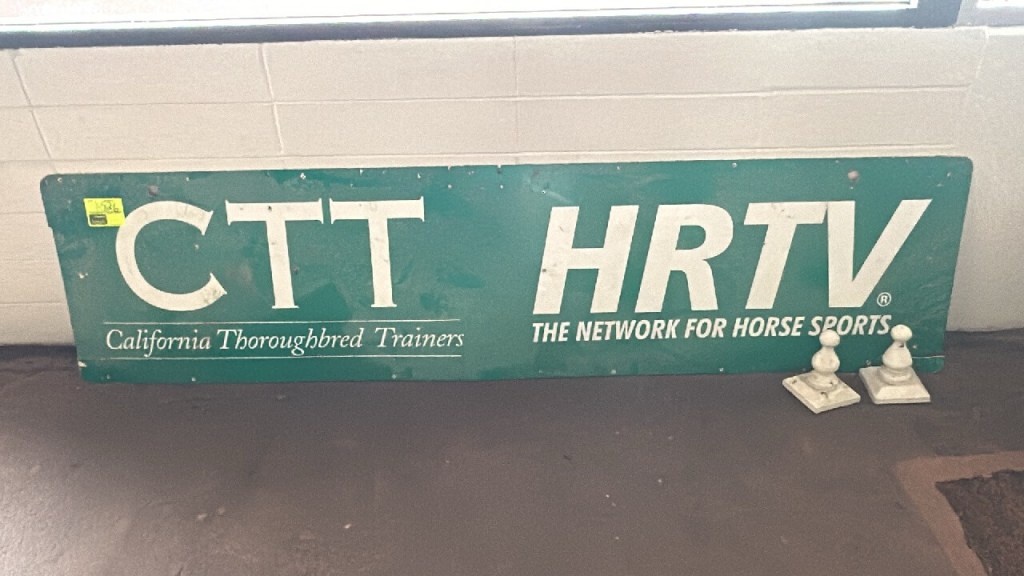
Up for bids was a green sign that included four white, magical letters representing the TV network that launched my career. To me, they represent a much happier, more innocent time in the game.
The sign brandishing the HRTV logo now resides in my office/guest room. And it’s brought up a lot of nostalgia, especially over the past few days.
We’ll get back to that, but first, it’s time for a trip down Memory Lane…
– – – – –
I desperately needed a reset (for both personal and professional reasons) in the late-summer and early-fall months of 2013. On a whim, I sent my resume to HRTV, and a few weeks later, I interviewed for a job on their digital media team. It went well, and in October, my dad and I stuffed my Chevy Impala with everything it could hold and drove it cross-country.
A lot of things changed over the next year and a half. I met the woman I’m going to marry next year, I worked with some incredibly smart people, and I did plenty of things I’m very proud of. I’ve told a few of these stories elsewhere, and you may have seen them, but they’re worth telling again.
Jeff Siegel and Aaron Vercruysse were some of the best allies one could ask for. They gave me opportunities to help them with a lot of HRTV’s “over-the-top” coverage. With the approval of my then-supervisor, Phil Kubel, these “Santa Anita Uncut” and “HRTV Extra” broadcasts helped establish the blueprint for the streams you see on YouTube, Twitch, and other social media outlets today. I’m forever grateful to them for that, and, in one particular instance, for going to bat for me when they didn’t have to (that’s a story for a much, much different time).
I helped Jeff with a stream from the 2014 Belmont Stakes, when California Chrome went for the Triple Crown. At some point that week, I found myself in the HRTV trailer with Caton Bredar, who I’d only met a few times before then. She smiled at me and said, “are you trying to steal our jobs? You were really good!” I’ll never forget that.
The team, as a whole, was one of the most talented I’ve ever been on, and not just in live production. The folks who put together the “Inside Information” documentary series did brilliant work telling some of the sport’s most interesting stories, including ones that were off the beaten path. In particular, the one discussing the Saratoga WarHorse Foundation was an all-timer, and it’s an absolute shame most of the documentaries in that series aren’t accessible online in some form or fashion anymore.
(Paging anyone with access, either at FanDuel TV or XBTV: Can we rectify this somehow? That’s a VERY easy way to get quality programming out there!)
I remember Millie Ball establishing herself as one of the toughest people I’ve ever met just by showing up. Her husband, Tim Yakteen, trained 2013 Breeders’ Cup Sprint contender Pointsoffthebench, a horse that suffered a fatal injury training for the race. It was a terrible breakdown, and nobody would’ve blamed Millie for going home. Instead, just a few hours later, “Race Day America” went live with Millie sitting next to Peter Lurie, and she gutted it out on the air.
I also remember one of the all-time great pivots in the history of sports television. Gulfstream Park had scheduled a mandatory payout of the Rainbow Six jackpot pool. Officials anticipated a final pot of more than $20 million, and HRTV’s programming included extensive analysis of that sequence.
There was just one problem: Dan Borislow etched his name in the handicapping history books by scooping that pot the day before the big one (to this day, horse racing Twitter refers to a jackpot hit right before a mandatory-payout day as a “Borislow”). This, of course, meant that Gulfstream Park missed out on a record-breaking handle day. It also meant that a TV network owned by the same parent company needed to alter its programming on the fly!
They somehow got Borislow on the phone while Kurt Hoover was on the desk. Kurt’s a pro’s pro who still does a fantastic job on FanDuel TV and FanDuel Racing, but he got a bit frustrated when Borislow didn’t seem to understand a question about the construction of his ticket. The lucky handicapper finally got the message and said something to the effect of, “that’s a great question!”
“Yeah,” I remember an annoyed Kurt saying, “that’s why I asked it twice!!!”
Horse racing makes it hard to be a fan sometimes. For the most part, HRTV made it easy.
– – – – –
HRTV was purchased by the company then known as Betfair in early-2015. To Betfair’s eternal credit, they hired many more HRTV employees than any of us thought they would. I wound up there for a bit more than two years.
(My first two years there were fabulous. It took quite a while, but my last two months were avenged by karma earlier this year.)
After a stop at The Daily Racing Form, my full-time work ceased to be in the horse racing business in late-2018. I still, of course, do quite a bit of freelance work in the industry with outlets like the Hong Kong Jockey Club, The Paulick Report, and The Saratogian, and that, combined with a full-time job elsewhere in the gambling world, is enough to keep me happy.
One other freelance assignment I’ve had materialized after I moved to Northern California. The NorCal fair circuit’s then-announcer, Chris Griffin, was looking for guests to help with handicapping seminars at Pleasanton’s Alameda County Fair. I responded, one thing led to another, and I’ve spent part of the last several summers on stage offering my analysis and selections.
The fair circuit was a breath of fresh air. I love tracks like Saratoga and Santa Anita, but they’ve housed plenty of extraordinary races where one could hear a pin drop on the apron. If it’s a nice day at Pleasanton and a field of $2,500 claimers spins into the stretch with each horse having a shot, the entire grandstand starts roaring.
I was on-site for Pleasanton Mile Day in 2023. It was the first-ever renewal of that race, and it was the richest event in North America that day. The weather cooperated, the track’s apron was jammed, and I couldn’t help but repeat the same axiom a few different times, to a few different people.
“A lot of places make it hard to be a racing fan sometimes. This place makes it easy.”
A few weeks after that day, a bunch of NorCal power players were in Sacramento for a charity poker tournament benefiting autism awareness efforts. A “breaking news” article by the LA Times’s John Cherwa dropped a bombshell: The Stronach Group (or TSG, as I’ll refer to them going forward) was pulling the plug on racing at Golden Gate Fields.
This was a Sunday afternoon. A few prominent people got about five minutes’ notice. Many got none.
The way this was communicated was unforgivable, and efforts to half-apologize during subsequent meetings and conference calls did not go over well. Ultimately, Golden Gate Fields ran a bit longer than TSG desired, closing in June of 2024 instead of December of 2023.
In an effort to fill the void, the fair circuit unified as Golden State Racing and proposed a new year-round Northern California circuit located at the fair tracks. TSG, predictably, was dead-set against this idea and, in response, floated a possible sale of Santa Anita Park.
To say that wasn’t well-received would be an understatement. TSG’s Craig Fravel, who has since left that company, was skewered over the threat at a mid-year CHRB meeting. Golden State Racing didn’t just get fall dates. It won them with unanimous approval.
I was there a few times during the fall meet, which will officially conclude Wednesday. Most notably, I guest-hosted the simulcast feed on Breeders’ Cup Saturday (combined with that night’s Sha Tin card, it made me, I believe, the first person to appear on two simulcast feeds, across two continents, on the same day; that’s a cool legacy to have!). It wasn’t the same as during the fair, when families popped in and out between going on rides and sampling fried food, but it was fun, and people wanted it to work.
News broke Monday, however, that Pleasanton will not run dates prior to next summer’s fair season. This leaves Northern California without a full-time circuit, and depending on how many horses stick around, the fair racing season encompassing stops in Pleasanton, Sacramento, Santa Rosa, Ferndale, and Fresno from June to October may be in doubt, too.
There’s no way this doesn’t stink. Fans in NorCal don’t have a full-time circuit to follow. Horsepeople need to make tough decisions, even if TSG makes good on plans to shuttle horses downstate. Will Santa Anita run lower-level claiming races than they’ve ever run at the Great Race Place? Will they offer races restricted to NorCal shippers? Or will their stock be forced to sink or swim against that of SoCal supertrainers who have consolidated most of the circuit’s fastest horses into a few select barns?
We don’t know these answers yet. However, these come from tough conversations the industry has shown it doesn’t want to have. If you’re not optimistic about this, I can’t say I blame you.
– – – – –
This brings us back to the sign. It’s the one that hung from the inside rail near the wire at Golden Gate for several years, and in addition to advertising HRTV, it also contains the logo of California Thoroughbred Trainers, which still shows its NorCal headquarters as Golden Gate Fields.
I won it at auction for $25, and I picked it up earlier this month. After being directed up the track apron by a lonely security guard, I parked across from the track’s main video board and took a look around.
The track’s Tapeta surface had been scraped up and plowed to the side, moreso resembling a brown snow bank than anything else. The infield’s grass wasn’t a pretty sight, the flags had long ago been removed, and the track that, just three years ago, saw eventual Preakness winner Rombauer capture the El Camino Real Derby was hauntingly quiet.

I picked up my sign, as well as a framed picture of a jockey covered in mud. The sign had a few cracks from being moved around, and I’m sure those didn’t get better as I figured out how to fit it into my Hyundai Sonata. I finally succeeded, bringing something that reminded me of such joy out of a place that reminded me of the very real hardships facing the industry at the moment.
Golden Gate’s gone. The NorCal fair tracks may follow suit. In addition, these events don’t necessarily ensure the survival of the SoCal circuit. Even if there’s no NorCal circuit to compete with, horses still aren’t being bred the way they once were, the horses that are bred still don’t run as much, and more lucrative racing options exist in other states.
Everything that’s happened in California makes it harder to be a horse racing fan.
I miss the days, the places, and the people that made it easy.
 Andrew Champagne
One comment